Learning Hebrew
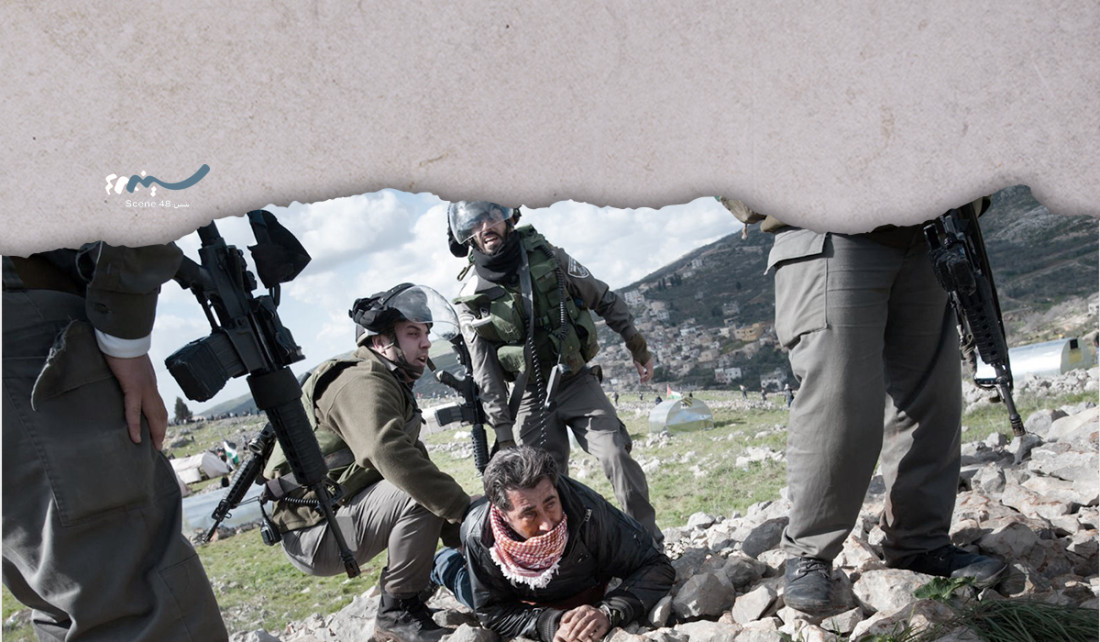
Mother took charge of family affairs the moment father was arrested at the border. Israel had imposed a new tax on West Bank businesses and wanted to set some examples. I was merely twelve years old in the mid-1980s when it happened. “A quiet time,” the TV news billed it while their cameras zoomed at the raging Iraq-Iran war. Quietly, the occupation crept, one parcel of land at a time, along with illegal and unfair taxes to squeeze us into submission.
I have never seen my mother like that before.
She had played the role of the passive housewife quite well: cooked, managed the home, and raised a brood of children. Publicly, she accompanied my father everywhere, or entertained family guests while remaining invisible, modest, and in true Catholic fashion, self-effacing.
Privately, she knew every detail of the family business. Father wouldn’t dream of taking any decision without consulting her.
Upon his arrest, it fell on her to organize his defense. While my brothers minded the store, she made countless trips to Jerusalem to meet with lawyers, and Tiberias where he was held for the court hearing. She also had to arrange for the bail. I was too young to feel the enormous stress and responsibility she was bearing. I trusted it would all work out. After all, she was the most capable person for the job. She knew Hebrew.
“If you want to win, you have to learn the language of your occupier,” she would tell me.
A Nakba survivor herself (she was sixteen in 1948 when she lost her home in Yafa), she learned Hebrew soon after the occupation followed them to the West Bank in 1967. My grandfather had gotten seriously ill and someone needed to communicate with the doctors at Hadassah hospital. Learning the language of the occupier was no obstacle when what she cared about was preserving family, freedom, life and love.
. . .
For years, she would be the one to get us out of trouble, and trouble those days was easy to find when you’re driving around with a West Bank license plate. We stop by the side of the road for a minute, and whoosh, a Jeep pulls up behind us. “This – is – a – closed – military – area” they would warn us in robotic English, and begin the questioning. That’s when she’d surprise them with Hebrew, and instantly their attitude would change. It was as if the soldiers respected those who spoke their language.
I never quite followed her injunction. Studying the Hebrew book she had given me, I eventually stumbled at ‘Aliyah’ and ‘Ole Hadash’. I found the concept of ‘rising’ to take my land and rename it ‘Eretz Yisrael’ repulsive, and quickly developed a mental block at the language. Maybe I didn’t want their respect.
For decades, I carried this aversion to Hebrew with me. It was the concocted language used for names of the settlements (or rather, stolenments) shadowing our villages and towns. The same language with which they ordered us around at the checkpoint, the ‘mahsoom’. I resented how our Palestinian Arabic was gradually polluted with terms from this invasive language. Every two years, I come back from America for a visit, only to find more new words have crept in. ‘Belfone’, ‘Arnona’, the special tax. Often the new terms describe burdens and restrictions the occupiers impose.
At the mahsoom my mother waited in 2002, in an ambulance after breaking her hip. By then, the soldiers didn’t care whether anybody spoke Hebrew. Their orders were to make her wait. With the Wall going up, we were becoming invisible to them. Lucky it was only a broken hip and not a heart attack. Others have died at the mahsoom.
Was my mother correct? Is it critical to learn the language of the occupier? Isn’t that a tacit acknowledgment that they’re here to stay? Does the value of learning their language overcome the inherent compromise? In 1988, during the First Intifada, I didn’t care to fit in. I just wanted them to go away.
Here I am writing this in English, another colonizer language passed down through my parents and teachers. I imagine my grandmother, a young woman of eighteen when the British invaded, facing the same choices. She was the one who taught me English. I was told she was English teacher when my mother was young.
Is writing in English a form of mental colonization? Shouldn’t I be writing in Arabic if our goal is liberation?
. . .
A couple of years ago, I was halfway through a movie in Hebrew, when I noticed that I wasn’t bothering with the subtitles. I did listen to my mother, after all, and I did learn Hebrew. I just refuse to speak it.
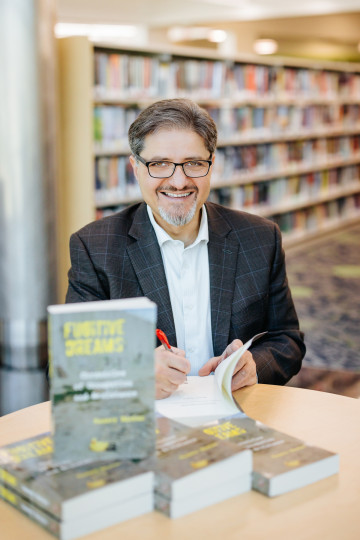
Dr. Ramsey Hanhan
The author of two books: the autobiographical Fugitive Dreams (2022), and a forthcoming collection of poetry and essays on Gaza, Palestine Bleeds for You (2026). His short stories, essays, and poetry appear in The Harvard Advocate, Fikra magazine, Scene48, and other publications. Formerly a physics professor, Ramsey holds a Ph.D. from the University of Michigan and lives near Baltimore, Maryland. His writings can be found at ramseyhanhan.org or ramsey-hanhan.medium.com.
Related Articles