People-Power-Planet Nexus in a Region Struck by Wars: A Faith Perspective
The People-Power-Planet nexus, examined through a faith lens, stops being merely a theoretical framework and becomes a moral call to action grounded in the Islamic principle of Al-Mizan. This means balance, the equilibrium that should be maintained in all aspects of life, including the relationship between humanity and the environment. Islam regards this Earth as a sacred trust, and humans as its trustees, or stewards, who have a duty to maintain that balance.
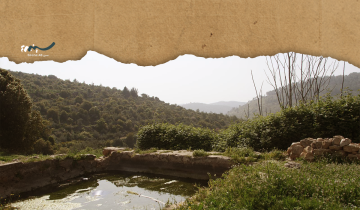
In the context of Palestine and the broader SWANA region, talking about the “Planet” often carries the underlying meaning of the “land.” For farmers, fishermen, and others in this region who depend on the Earth for their livelihoods, the land is not just a resource. It is hope, culture, identity, prayer, and life.
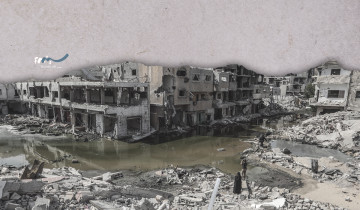
Unfortunately, this vital balance and this relationship with the land are being torn apart because of ongoing wars, resource control, and a worsening climate crisis.
A Breached Sacred Trust
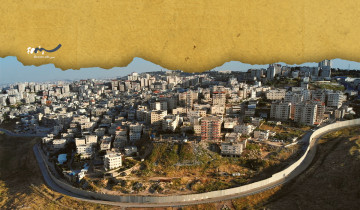
Across the occupied landscapes of Palestine, assertions of power take the form of control over life-sustaining elements and the disruption of Al-Mizan. Under this systematic environmental destruction, the land no longer holds the spiritual meaning of Amanah, but is instead deliberately used as a tool to sustain oppression. Control of land does not only reflect disputes over soil and borders; more importantly, it is about dismantling a region’s soul, identity, and the means to sustain life for generations to come.
In its illegal occupation, Israel uses legislative dispossession and operates under the guise of green colonialism to facilitate the seizure of large parts of fertile Palestinian land. The truth is that Palestinians, who have farmed and cared for these lands for generations as their indigenous stewards, are forcibly excluded and denied access to natural resources that are rightfully theirs and vital for the subsistence of their livelihoods and those of future generations. When ancient olive trees, many of them more than 1,000 years old, are burned to the ground, an entire ecosystem suffers, and the connection between the people, their land, and their heritage is deliberately cut.
Who Bears the Heaviest Cost of Delayed Justice?
As in any crisis or disaster, the most vulnerable pay the highest price. In Palestine, vulnerabilities caused by the climate crisis meet the suffering and devastation caused by war, severely undermining human resilience and lives. While the SWANA region is warming at nearly twice the global average, rising temperatures combine with political instability to create a broken system in which enforced scarcity of resources such as water becomes a means to an end. For example, by controlling the flow of the Jordan River, the Israeli army turns a natural resource into a tool of control and deprivation.
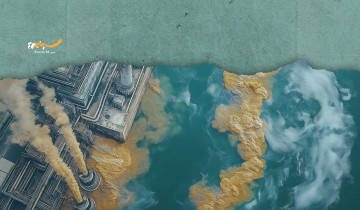
In both Palestine and Lebanon, destruction and violence also extend to the Earth itself, as chemicals used in weapons and bombs poison the soil, render land barren, and destroy biodiversity. This deliberate corruption of the Earth ensures that lands are not only occupied but also compromised for generations to come.
Justice, i.e., ’Adl in Arabic, as referred to in Islam, must be approached holistically while protecting the most vulnerable among us. Justice cannot be achieved without restoring balance, preserving the rights and lands of communities, and treating the Earth as an Amanah rather than a space to exploit. Climate justice, in particular, cannot be obtained when the environment is used as a weapon of war and oppression, ruined and controlled, burning years of people’s history and way of life.
A Spiritual Duty
Islam calls for protecting the most vulnerable and the oppressed and for stopping those who spread corruption on Earth. Applying the “People, Power, Planet” nexus in the context of the region, and particularly Palestine, means the cry of the people should be considered equal to the cry of the Earth. Both come together, and both must be addressed in a just and sustainable way.
Justice looks like fair access to water based on need, it looks like an olive tree growing and thriving, it looks like a generation of farmers tending their land and prospering. Justice happens when soil, trees, and water are reunited with their indigenous stewards. Justice ensures that whatever blessings this Earth has to offer flow freely.
As we face multiple threats, uncertainties, and interconnected crises in the SWANA region, this Hadith comes to mind: "If the hour is about to be established and one of you has a palm seedling in his hand, then if he can plant it before the Hour is established, he should do so." In our region, planting that seedling is itself an act of faith, defiance, and hope for a better future.
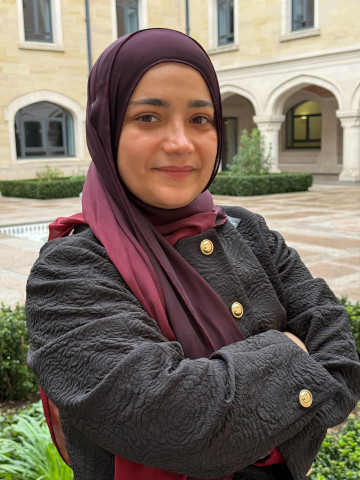
Nouhad Awwad
The Ummah for Earth Campaigner and Global Outreach Coordinator at Greenpeace-MENA. She holds a BSc in Environmental Health and an MS in Environmental Sciences (policy planning) from the American University of Beirut, completed the One Health Program at Duke, and studied U.S. foreign policy at George Washington University. She founded the Arab Youth Climate Movement chapter in Lebanon (2015), participated in COP21–COP28, served as YOUNGO focal point (2017), and was named by UN Women (2021) as one of nine influential women in Lebanon. In 2023 she was listed among the top 30 global leaders advancing climate solutions.
مقالات متعلقة