I Wasn't No. 1 … And That Was My Strength

During one of the weekly meetings of the Ramallah Municipal Council, as the discussion grew tense over a decision that was anything but easy, I found myself watching the scene from an unusual angle: How many women were in this room? And how many of those voices were actually being heard, not merely permitted to speak? In that very moment, I saw my mother, Doris Khoury, in my mind’s eye, sitting beside me watching the way she always watched, in a silence that concealed a clear decision.
My mother was never “number one” in any official sense. She held no title and never stood at the front of a stage. But at every stage in my life, and in every family decision we ever faced, she was the voice we turned to before the decision was made, not after. From my mother, I learned that real power isn’t measured by where you sit at the table, but by what happens in the room after you speak.
Between Running for Elections and the Taking the Seat
When I ran for mayor of Ramallah, I believed the only meaning of winning was reaching number one. I came from a background that wasn’t political in the traditional sense: a translator, a linguist, a Scout leader, a woman who was used to being the bridge between two languages and two cultures more than she was used to standing at the front of the picture. When the result placed me on the council instead of making me mayor, I allowed myself a brief moment of disappointment. But that moment didn’t last long.
I quickly discovered that the second seat, or the third, or sometimes the tenth, is where the real decisions are made, before they ever reach the voting table. In the committees, where a decision is still raw and open to being shaped, where debate is still open to hard questions, that is exactly where I found that my voice made a difference no less significant, and sometimes greater, than the voice of whoever sits in the first chair.
Dynamics No One Told Me About
No one told me, before I walked into the council chamber, that being a woman meant I would be asked to prove my readiness twice: once with the argument, and once with my presence. I noticed, as many women before me have noticed, that a man’s opinion is sometimes taken as a given, while a woman’s opinion has to be built, point by point, before it is heard.
But over time, that challenge became a tool. The extra preparation this dynamic forced on me often made me the most prepared person in the room. And I learned that collective decisions, especially in municipal work, which is so close to people’s daily lives, are made better when two ways of thinking come together: one that leans toward quick resolution, and one that leans toward listening and gradually building consensus.
Councils where women and men work together as genuine equals, rather than merely appearing to do so, tend to reach more durable decisions because those decisions have been tested from angles neither side could have seen alone.
The Power of Being Number Two
I learned to tell the difference between two kinds of power: power that is displayed and power that is exercised. The first needs a platform, a title, a spotlight. The second can be exercised from any seat in the room, as long as the woman holding it knows exactly where to place her hand on the decision.
A woman who is “number two” is no less influential than “number one.” Sometimes, she is freer. She isn’t burdened by the weight of the public image alone, and she can direct all her energy toward substance: the file, the detail, the actual impact on people’s lives. This is exactly what my mother taught me from the time I was a child, without ever once using the word “leadership”: that you can have influence that needs no title to prove it.
To Our Mothers, and Those Who Come After Us
When I think today about my own path, from the translation halls of London and Beirut to the council chamber in Ramallah, I realize that the thread connecting all these stops isn’t an ambition to reach the top, but an insistence that my voice carry weight wherever I sit. This is a lesson I carry from a woman who never once asked to be first, but who was, in every decision our family ever faced, the real power behind the table.
To the women stepping into decision-making rooms today, municipal and national alike, I say this: Don’t wait for the first seat to begin making an impact. Power exercised from the second seat, when exercised with steadiness and awareness, builds something no title alone can build: the confidence that a woman, wherever she sits, makes the decision.
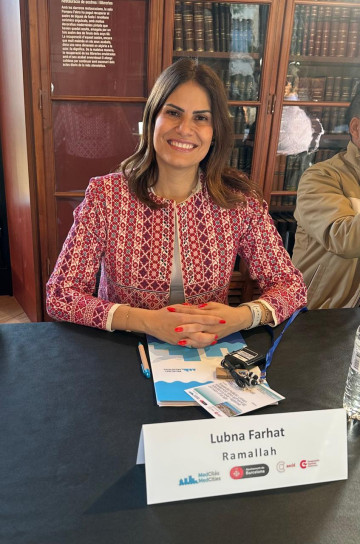
Lubna Yousef Farhat-Qattan
Born in Jerusalem and educated at the Friends School, Ramallah, holds a BA in English Literature from Birzeit University and a postgraduate degree in Translation/Interpretation from Durham University, UK. A translator and interpreter with EUPOL COPPS since 2012, she previously worked in translation and public relations in London and Beirut. From 2022 to 2026, she served on Ramallah Municipality’s council, chairing committees on culture, HR, environment, waste management, and IT. An active community advocate, she sits on the board of First Ramallah Group, leading its PR committee, and is a member of Dunya Women’s Cancer Center and other civil society organizations.
Related Articles