To be a Palestinian Today
I
In a sunny humble classroom at the National Pedagogical University in Bogotá, Colombia where I was recently giving a talk, an undergrad posed an unexpected question. “What does it mean to be Palestinian today?” she asked.
I felt that I could answer with the regular platitudes about steadfastness, hope, and our people’s unwavering commitment to our struggle; which are all true, but are equally not the full story. I found myself answering with what I had been feeling recently: To be Palestinian today, I said, is to be uncertain whether you will be Palestinian tomorrow; to not know what the future holds, on a very substantial level.
That is, will one be, at all, tomorrow? Will one be in Palestine? What will Palestine or Palestinianness look like? Will Gazans still consider us their brethren, two years into genocide, being left to their fate?
What will the region look like? What will its borders, or its peoples and their relationship to Zionism look like? Will we see Suwaydans manning IDF checkpoints in the West or East Bank? Will we see settlements in Lebanon? Etc.
Dark scenarios are not difficult to imagine, but our current reality, even if we got used to it, is the dark outcome of past junctures not unlike this one.
II
I had recently passed through Jordan, as we have to on the way to or from the West Bank. For some reason, this trip in particular felt eye opening, as if I understood for the first time the prospect of the “alternative homeland.”
Years back, when relatives used to pronounce that they are “Palestinian Jordanians” (Palestinian being an adjective, modifying their primary Jordanian identity) I dismissed that as delusional or at best a cope. I now realize it wasn’t, even as their statements today may differ. I was shocked at how distant most Palestinian-descendants I met in Jordan were from the daily reality of Palestinians in the nearby West Bank. Not in the sense of not caring, but simply not knowing. A taxi driver, a shop owner, an upper middle-class expat, all displayed interest and empathy, but also asked very basic questions about Palestine’s present reality.
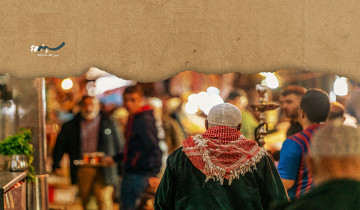
At the same time, I could see in Amman what Ramallah is becoming. Palestinianness as a mere cultural signifier in a consumerist society. Tatreez (i.e., embroidery) embellishing fancy foreign-made dress. Stickers and souvenirs. Watermelon tote bags carried proudly by young professionals, remote-working in a downtown coffee shop, likely on projects in the Gulf. A keffiyyeh sold by an old man in his “made in Jordan” shop, slow to reveal that he’s a refugee from Lydd. Life seemingly moving on as usual for a substantial strata, while genocide is creeping right at the corner.
In Ramallah, a thobe-draped Palestinian fellaha is now the new logo of an upscale local coffee shop chain—who said that Ramallah hasn’t heeded the calls of the Flood? And while al-Sham is maybe done for[1], and al-Aqsa is out of reach, the West Bank recently got its own three Bekdash ice cream branches, and ‘Umra is a click away, at least for those who can afford it, so who cares?
III
In reality many do care. Many have risen up and sacrificed alongside Gaza, in the villages and refugee camps of the West Bank, but also in Ramallah and in Amman, and the world over.
Decades ago our people survived the Naksa and the Nakba. I often imagine how they must have felt even before that, as their world changed with the fall of the Ottoman Empire and the arrival of colonial rule, with borders suddenly emerging, and soon enough nation-states and corresponding identities. These were seismic shifts, yet the people of this region remained, and Palestinians continued to fight.
Nonetheless that is also the history that led us to where we are now. The dark possibilities I opened with are not at all certain, but they are possible. Understanding this is key to acting in accord with the gravity of this moment.
I believe that we are in a war of civilizational dimensions. We have long been, but Gaza’s self-sacrifice has made this inescapably clear. This is a war on humanity and its future, and it is a war on the very being and identity of Palestinians, Arabs, and Muslims. A war on the possibility of a diverse yet equal humanity, including on the potentiality of a sovereign Arab region, or a consolidated and sovereign Muslim nation.
Palestinianness (and Palestine) may be relegated to a “land acknowledgement,” and it may as well be sublated into a broader Arab or other identity in a radical remaking of this region and the world.
This uncertainty, this existential dread, I believe, is the corollary of the malleability of the future. It is also a reflection of a deep feeling of potential agency in it and responsibility towards it. Gaza has teared open the horizon, what remains to be done is left to us; and this is the daunting part. Realizing that the nature of Palestine, the region, and the world is yet to be determined, is also realizing that the weight of obligation we carry towards this future, and the enormity of the task ahead.
This is what being a Palestinian today means.
[1] This is a reference to freed prisoner and exile Mahmoud al-Arda’s recent spontaneous utterance “raahat al-Shaam” (al-Sham is done for or is gone) which generated controversy among highly-esteemed keyboard warriors and bots alike.
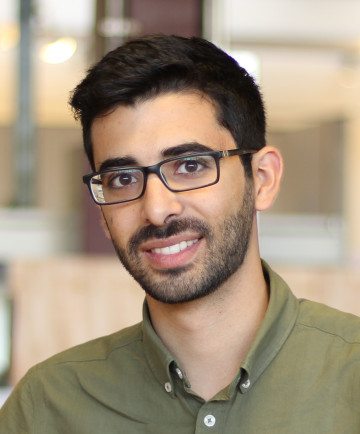
Faiq Mari
An architect and researcher, and assistant professor at Birzeit University. His work explores the spatiality of Palestinian struggle, and has focused on collective labor and property therein. His writings appeared in the Journal of Palestine Studies, the International Labor and Working Class History journal, Bab el-Wad, and other journals and edited volumes.
Related Articles