All They Will Find Is Sand
The UN Genocide Convention of 1948 lists five acts that constitute genocide when committed with the intent to destroy a group in whole or in part. The third prohibition, framed in Article II(c), forbids ‘deliberately inflicting on the group conditions of life calculated to bring about its physical destruction’. This refers to indirect forms of killing, those that don’t target human bodies but the environment that sustains them. Sufficient ‘conditions of life’ require buildings, hospitals, social infrastructure, sewage and water systems, power grids, agriculture. The intentional destruction or degradation of such structures undermines a people’s ability to survive, leading to a slower and more tortuous form of annihilation.
The idea that the built environment determines a group’s conditions of life recalls the modernist conception of architecture, prevalent when the word ‘genocide’ was first conceived and defined by the Polish Jewish jurist Raphael Lemkin in his 1944 book, Axis Rule in Occupied Europe. Lemkin defined genocide as being aimed at ‘the destruction of essential foundations of the life of national groups’. He was thinking about the way the Nazis saw the Jewish ghettos and enslaved labor camps as means of slow, indirect extermination. But he was also aware of the colonial origins of this mode of destruction.
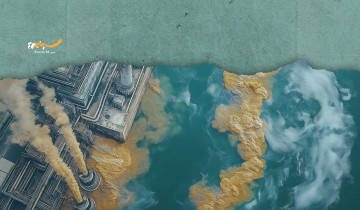
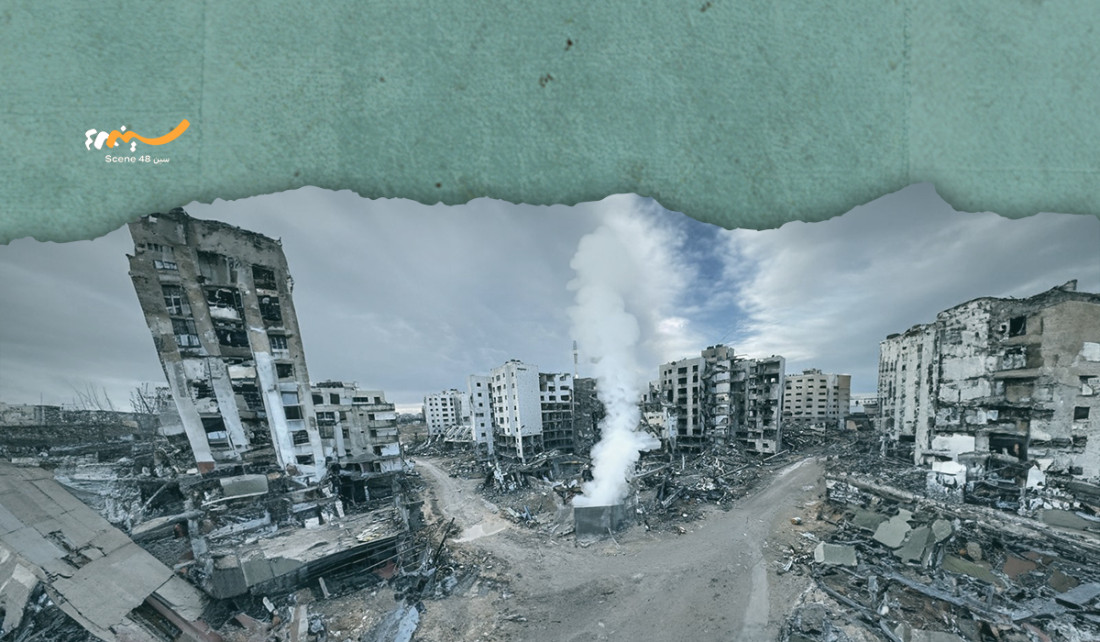
Two and a half years after 7 October 2023, most of the Gaza Strip – cities, refugee camps, schools, universities, mosques, the health infrastructure, agriculture, wells and the soil itself – has been destroyed and made toxic by bombs, artillery, tank shells and sappers. The most systematic destruction was caused by D9 bulldozers made by the US company Caterpillar. The tide of destruction flowed inwards from Gaza’s perimeter fences, pushing Palestinians into enclaves referred to by the Israeli army as ‘safe areas’ and ‘humanitarian zones’, though they were never safe or humane. Entire cities such as Rafah, towns such as Beit Hanoun and refugee camps such as Jabalia were erased. When buildings are bombed or bulldozed, their remains – plastics, wiring, solvents, insulation, asbestos – release toxic chemicals into the soil. Some bombs penetrate the ground before exploding and release heavy metals or metalloids – such as uranium, lead and arsenic – deep underground. Many of these substances are slow to decay and will affect the composition of the soil for decades. A lived-in landscape has been turned into what a former Israeli general, Giora Eiland, described as a place ‘where no human being can exist’. In Gaza the systematic devastation of the environment – fields, water sources and the fishing industry – destroyed the ability of the society to feed itself. Attacks on schools and mosques reduced its capacity to organize and offer mutual care to mitigate the worst effects of scarcity, thus aggravating famine. The simultaneous destruction of one domain amplifies the harm caused by the other.
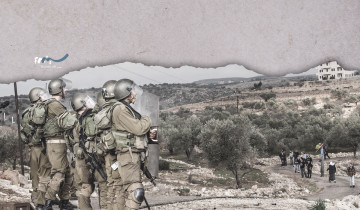
The destruction was most complete close to Gaza’s fences. The IDF calls the area bordering Israel a ‘buffer zone’. It is a no-go area for Palestinians, a shetah hashmada, Hebrew for ‘annihilation zone’: any Palestinian entering it, or sometimes even approaching it, is shot on sight. The flattening of all structures in the buffer zone was intended, among other things, to remove any hiding places and expose Palestinians to snipers. The army ‘changed the Strip’s topography beyond recognition’, the Palestinian poet Omar Moussa wrote that month. ‘If we survive this war,’ he quoted a friend as asking, ‘what would be our meeting point?’
Throughout the past two and a half years, Gaza has not only been a demolition zone but a construction site, reshaped according to Israel’s blueprint. The bulldozed remains of buildings were piled into a landscape of earth berms, which were then shaped into barriers, detention facilities and military outposts from which Israeli tanks and snipers commanded the area where survivors were concentrated. The scale of the earthworks was so great that Israel’s two hundred bulldozers were not nearly enough – many were damaged by the Palestinian resistance – and Israel urgently needed two hundred more.
The present ‘ceasefire’ came into effect on 10 October 2025. Under its terms Gaza was divided into two zones by a Yellow Line that ran roughly along the edge of the buffer zone, leaving the Israeli army in control of 54 per cent of Gaza. By December, Israel had unilaterally shifted the line west, bringing the area under its control up to 58 per cent. Eyal Zamir, Israel’s chief of staff, described the Yellow Line as Israel’s ‘new border’ with Gaza.
The line was drawn along a sandstone ridge that runs parallel to the coast, around three kilometers inland. At about seventy meters above sea level, it offers Israeli forces control of the Palestinians forced into the area near the sea. The ridge has organized life in the region since antiquity. Every year millions of cubic meters of granite from the Ethiopian plateau erode into sand that is carried down the Nile into the Mediterranean. Tides deposit large quantities of this sand along the Palestinian shoreline. Millennia ago one of these ancient dunes petrified into the sandstone ridge – a formidable barrier that dams the eastward drift of other sand dunes along the coast. West of the ridge the area is primarily sand; east of it, the soil is fertile. For many generations most of Palestine’s wheat and barley fields were cultivated by Bedouin tribes in the fertile plains of the Beersheba region. These farmers were among the two hundred thousand Palestinians expelled from their land and incarcerated in a beachside enclave between the towns of Rafah and Gaza in the final months of 1948. A sliver of this soil between three and four kilometers wide remained within the borders of Gaza. In recent decades this fertile land was Gaza’s breadbasket. Now all of it is on the Israeli-controlled side of the Yellow Line.
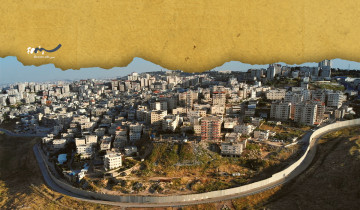
At Forensic Architecture we identified a new earth berm that has been built along much of the path of the Yellow Line, as well as seven new military outposts. One of them was constructed on the site of a cemetery. Altogether there are 48 outposts east of the Yellow Line. At first the new outposts were no more than piles of earth and rubble, organized into variously shaped enclosures. But in recent months the enclosed areas and the roads leading to them have been asphalted. Electricity poles have been erected and the roads lit. Closely packed prefabricated buildings have been erected inside the bases, and tall towers on the perimeter carry communications and surveillance equipment. The bases no longer appear to be the provisional arrangements that Trump’s ceasefire plan claims them to be, but permanent instruments of occupation. The newly paved roads connect the bases to a matrix of control that is linked to Israel’s road network and communications grid.
The settler movement is lobbying hard for the Israeli government to start constructing settlements within the vastly expanded buffer zone. In the meantime, fanciful development plans are being floated to cover up the reality of the ongoing destruction of Palestinian life in Gaza, which has become a feeding ground for real-estate sharks cum politicians. To pre-empt Trump’s Riviera plan, Egypt, Saudi Arabia, Jordan and the UAE proposed their own masterplan. It was evidently designed to please the Israelis. The buffer zone was integrated into the plan, represented as an ‘open green area’ where no structures were to be built. In the summer of 2025, a group of Israeli entrepreneurs presented another initiative, the Gaza Reconstitution, Economic Acceleration and Transformation Trust, or GREAT. Some Palestinians could remain; others would receive meagre financial assistance towards moving elsewhere.
The ceasefire of October 2025 created an opportunity for this plan to be updated. The Board of Peace is a who’s who of populist authoritarianism: Trump as chairman for life was joined by Benjamin Netanyahu, Argentina’s Javier Milei, Hungary’s Viktor Orbán, Jordan’s King Abdullah II and Turkey’s Recep Tayyip Erdoğan. A new military body known as the International Stabilization Force would take over security control. As Shawan Jabarin, director of the Palestinian human rights organization Al-Haq, said to me, the proposal involved only a semantic change in the logic of occupation: the ISF would simply replace the IDF as an occupying power.
Kushner presented the Board of Peace’s architectural vision at the World Economic Forum in Davos. Project Sunrise added detail to the hallucinatory vision of a riviera with renderings of 180 luxury high-rises, behind which seven clusters of urban and industrial developments were separated by wide roads that traced the route of the military roads constructed by Israel since October 2023 to slice Gaza into controllable sections. East of them was the buffer zone camouflaged as an agricultural area.
In January, Forensic Architecture researchers identified site-work taking place in an area of one square kilometer, surrounded by several military outposts, on the Israeli-controlled side of the Yellow Line, just east of the ruins of Rafah. A leaked US military document revealed that this was a pilot for a program called Alternative Safe Communities, which will offer accommodation to tens of thousands of Palestinians, vetted for their willingness to renounce Hamas, in communities of modular homes supplied with water, sanitation and electricity; mosques and schools will promote normalization with Israel in line with the curriculum used by the UAE. An indicative illustration of what is referred to as the Emirati Compound shows the layout of a new type of refugee camp. In the plan, two-story prefabricated units – not tall enough to ‘threaten’ Israeli forces – are laid out along wide streets that allow Israeli armor to patrol. At the center is a large park surrounding a single-story mosque. This, rather than luxury housing and a riviera, is the most that Palestinians can hope for from the reconstruction plans. Residents would enter and exit the fenced-in camp through checkpoints equipped with biometric sensors. The plan also offers help to ‘residents wishing to travel abroad’.
All these initiatives ignored Palestinian planners and architects, although several Palestinian reconstruction plans have been proposed. One of them, the Phoenix Gaza Initiative, was prepared by the Union of Gaza Strip Municipalities, working with Palestinian architects in Palestine and the diaspora, and is grounded in the ‘social and spatial relationships that persist in Gaza’. Erased neighborhoods and refugee camps – some of which, like Rafah and the Jabalia, are historic centers of Palestinian national identity – are to be replaced, home by home, after carefully re-establishing the land ownership of the erased surface. During the process of reconstruction, each family would be housed near the site of their demolished home, and communities would be involved in the reconstruction.
Reconstruction plans imposed on Palestinians with the implicit aim of destroying Palestinian life in Gaza demonstrate the reason Lemkin reserved a place for architecture in his conception of the crime of genocide. He knew that the way a people organizes its space is a manifestation of its history and social structure. ‘Genocide has two phases,’ Lemkin wrote in Axis Rule in Occupied Europe. The first involves the ‘destruction of the national pattern of the oppressed group’ – this was achieved in Gaza by Israel’s devastating bombing. The second involves the imposition of a design by the oppressor, like these reconstruction plans for Gaza. ‘This imposition, in turn,’ he wrote, ‘may be made upon the oppressed population which is allowed to remain, or upon the territory alone, after removal of the population and the colonization of the area by the oppressor’s own nationals.’
Eyal Weizman
One of the world’s leading experts on the relationship between violence, conflict and the environment, both built and natural. As director of the organization Forensic Architecture, he and his team of interdisciplinary researchers document acts of state crimes and human rights violations around the world. Since 2023, the group has worked to produce evidence for the International Court of Justice’s genocide case against Israel.
مقالات متعلقة