How Do Women in Gaza Resist?
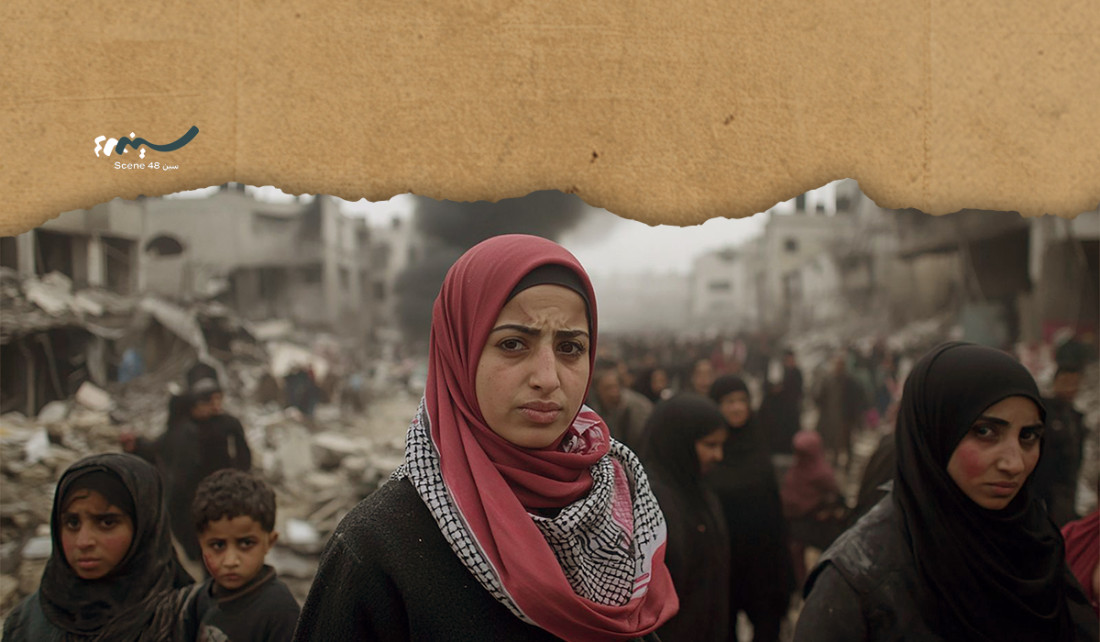
It is a contentious question that surfaces every eighth of March, followed by a bitter laugh at life and death, both indistinguishable in Gaza. International Women’s Day, once an annual reminder of the work still to be done, feels different this year. It compels us to linger over the days just passed and the years now behind us, even as our shadows stretch toward a future we can barely discern.
The bodies of women, and the shadows, have become an uncharted battlefield. Their bodies continue to resist in their own way. In the tent, a body may collapse, but it is a fleeting collapse, one the spirit utterly rejects. There is no luxury of breakdown here. No “warrior’s rest.” No “time-out.” With every breath of oxygen inhaled by women in Gaza, there is resistance to injustice and abandonment.
Our mothers, sisters, and daughters know no hand will break through the hardened walls, evade the unblinking cameras, or outrun the Israeli quadcopter drones that deliver daily death. No hand will reach Gaza’s vast prison to steady their bodies and their shadows. And yet, there is a hand not external, but radiant with faith, inner strength, and resolve for the sake of family and the few who have survived. It is the women’s own hands: hands of support, of inspiration, of patience, of endurance for the ones they love.
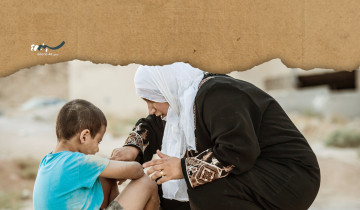
How many women have let their bodies falter so their children might swallow a mouthful of food? How many have shivered through merciless winter nights to radiate warmth into the small bodies gathered around them? How many have swallowed their pain and humiliation so their families would not collapse entirely?
Words have grown inadequate to describe the human depths in Gaza. For over twenty years, siege, deprivation, killing, and torment have pressed down, and in recent years, their brutality has only intensified. What seems an ordinary breath to those outside Gaza marks the beginning of an existential struggle for women and girls within it.
Some of that struggle is visible and documented in water lines that stretch across endless hours, in women running and stumbling behind water trucks far from their tents. Some of it appears in the desperate search for scraps of paper, dry branches, torn cardboard, anything that might, hours later, ignite into a flame capable of cooking a meager meal or warming children forced to grow up too soon.
And there are the whispered battles women carry within themselves: How to find warm water for a bath that might wash away exhaustion and the soot of fire? How to restore even a hint of the skin’s former glow? How to break the cycle of fear and waiting? Yet even these whispers are scorched by voices rising from within the tent: I want milk. I want fruit. I want toys. Trembling voices hemmed in by rubble and borders ask: Where is my school? I want my school. I want to go to university. Where is my university? I want to see flowers, trees, and birds. Is there no park left in the city?
Gaza’s parks have become cemeteries. No green trees remain to soothe the eye. They burned the trees and the homes and burned our loved ones with them. Who dares speak of the frailty in the soul? Is there a playground where children can roam freely? There is no time for playing. Play itself has lost its meaning when a child stumbles upon the remains of someone buried beneath the earth, father, a mother, and a grandmother.
Every step in Gaza is a harsh flirtation with death, a quiet execution of tomorrow’s dreams. A seventeen-year-old girl confides: “I’m deprived of school. I’m afraid that with time my family will marry me off young. There are no schools in Gaza, no safety. People watch girls our age, judging every movement.” These are not dreams in the romantic sense; they are rights. The right to childhood. The right to education. The young girl understands the price of her exclusion from school. A terrifying void awaits her. In a tent that protects no one, she faces a future without education, perhaps forced into early marriage. That fear now eclipses even the war.
In Gaza, the sun has forgotten the women’s hair.
Who guards the dreams of Gaza’s children? Who will declare that these are not wishes, but rights? Who protects women in the food and water lines? How do women withstand disappointment and grief? If you saw them, you would see they have lost their smiles but not their faith that they deserve a dignified life. The tent, that fragile canvas that shields neither body nor spirit, resists alongside them. They resist the idea of spending years within it by making it as clean as they can. They gather, laugh at the primitive conditions forced upon them, but they do not scream. Their screams have already scraped the sky for two long years as they fled from place to place, escaping rockets and grotesque tanks while clutching their children in their teeth.
How many women have wished they could return their children to the safety of the womb, to fulfill the sacred promise of protection? Who protects them now in this new jungle of a world that sees them merely as displaced, homeless, shelter-less, stripped of privacy?
Women in Gaza no longer comb their hair in wartime. Their hair seldom sees the sun; the tent’s holes are enough to cry out to an unjust world that women remain, despite the machinery of killing and slaughter. At dawn, they rise, hungry for daylight, because there is no electricity. At sunset, they gather their children, or photographs of those they have lost, and hold them close, as if to promise they will remain together, or die together.
Night in Gaza is long and pitch-black. Eyes close, but the exhausted soul awakens. Here, in darkness, women weep alone and soundlessly, breathing slowly as tears fall, suppressed grief, sorrow, and anguish. To whom can they speak of their wounds? Only to one another. They dream of a future with dignity: a home, even a caravan, a return to the rubble of what once was, perhaps to retrieve a memory, perhaps to recover the smile war stole from them.
They cloak themselves in silence. Their bodies labor day and night; so do their minds. Sleep is elusive with footsteps near the tent and the cries of hunger and deprivation pressing in from all sides. The night is longest for women, who lie awake thinking of their families, their past lives, their present lives, breathing heavily and asking: Is this life?
The world knows the perpetrator. The victims wait for their appointed time.
In March, once a space for reflection, for recalibrating our struggles, you are unrecognizable this year. You are harsh to the point of slow death, like a blade bending over women’s necks without mercy.
During the genocide, women and children wrote their children’s names on their bodies, bodies still ground into the existential question: to be or not to be. To survive, or at least to leave something behind. It is a forced gamble with death. Women now write their names upon the clouds of a sky they can no longer see, obscured by relentless aircraft that have driven even the birds away.
They cover their faces with the edge of a scarf so others will not remark on the gauntness, the darkened skin, the thinning features. They hide hands stained with soot. There are no mirrors intact, no proper bedrooms, no ceilings to protect privacy, no beloved to rekindle life. They struggle simply to survive, perhaps only the survival of the body. Thousands have not survived whole; limbs severed, they live in a shattered social vacuum, no treatment, no travel, no prosthetics, no mercy. Everyone runs to survive.
Life in Gaza is harsh to the edge of death, as if one’s bed were made of needles and pins. You cannot remain long without bleeding from every part of yourself as you fight to endure.
Women cut their hair; water is scarce and unclean. There is no luxury of varied clothing; laundry is yet another circle of suffering. Still, they resist with every drop they possess, washing clothes, then dishes, then the ground of the tent, until the water evaporates. Nothing is wasted. Not a single drop can be spared.
Their words stain us this eighth of March:
“They stole our privacy. They stole our time. They stole our years. They stole our dreams. But it is enough that we remain, so that they must one day ask themselves: After all this killing, siege, deprivation, and burial of women and girls in the twenty-first century, are they still alive? Is hope still alive?”
Do not ask how the women of Gaza resist genocide and daily death. Ask yourselves what you have done for them. Has your hand reached toward the tormented souls who are still resisting in Gaza?
Hedaya Saleh Shamun
A Palestinian writer and journalist from Gaza – Rafah.
مقالات متعلقة