Peace over Coffee

They didn’t speak the same language. In fact, they did not even share one. They met as colleagues.
No one introduced it as something special. No program, no peacebuilding or reconciliation initiative, no carefully designed encounter. Just a new assignment in a post-war society where cooperation had slowly become possible again. At least it was on paper.
They were expected to work together without a common language. They shared a few borrowed words and the universal vocabulary of pointing at documents.
So the first days were practical.
“Here.”
“This?”
“Yes.”
“No, different.”
They focused on tasks because tasks were safe. Work provided structure, and structure protected them from everything else. These two women behaved as colleagues anywhere might behave on the first day. Everyone is polite, efficient, distant. Except in this small place in the Balkans, the distance was not only professional. It was learned and inherited.
At some point the work paused. A short break, someone suggested. There is no need to go to the cafe here. Good, old Turkish coffee brings everyone together. None of them proposed making it together, yet none suggested doing it separately. They simply walked in the same direction, half a step apart, as if the decision had already been made for them.
One was in charge of cooking, the other of preparing cups. Two coffees, strong and dark, served in small cups. You can smell how strong the coffees are. Classic Balkans.
For the first time since the meeting, there was nothing to organize. They did not talk. And yet the silence in the coffee corner felt different from the silence at the office. At the office, silence protected efficiency. Here, it exposed its presence. Without papers, without tasks, they were no longer just two people cooperating. They were two people sharing time. And both were aware of it.
The coffee created a pause. A pause is seen as a legitimate reason to stay together without needing a justification. Leaving immediately would have felt intentional. Staying together was easier.
They did not call it dialogue. They did not call it reconciliation. There were no mediators, no microphones, no one observing progress. Nothing official took place. But this is exactly what it was. A moment where coexistence became possible in its simplest form. Preparing a coffee and having it together in silence.
The conversation that followed was small. A question about working hours. A complaint about public transport. A word searched for, replaced by laughter when pronunciation failed. Nothing important. And exactly because of that, everything was important.
In places like these, that were shaped by violence and separation, peace rarely begins with agreements. It begins when ordinary interaction stops feeling dangerous. Long before negotiations restart, before politicians shake hands and agree, people need to relearn how to share time without calculating risk in every sentence. And very often, it is women who first allow these spaces to exist. Not because women are naturally peaceful, and not because men do not want peace. But because war and violence reorganize daily life in a way that places women at the center of maintaining continuity. They become coordinators of normality. Normality at work, at home, in neighborhoods, in institutions that must continue functioning even when trust has collapsed. By the time official peace talks begin, they have already been practicing coexistence for years. They just call it work. And sometimes, simply coffee.
Recognized on Paper and what about the Practice?
Twenty-six years ago, the international community attempted to acknowledge this reality. In 2000, the United Nations adopted Resolution 1325 on Women, Peace and Security. It carried two fundamental messages. First of all, that women and girls experience war in specific and often devastating ways that must be recognized and prevented. Second, that women’s meaningful participation in peace processes should not be symbolic. It should be essential for preventing, ending, and recovering from conflict. Twenty-five years ago, it was a milestone. For the first time, everyday peacebuilders were formally recognized in global policy. Yet a quarter of a century later, the gap between recognition and reality remains striking. According to the UN in 2024, more than 676 million women and girls were affected by war and violent conflict worldwide. At the same time, women’s participation in official negotiations and mediation processes still fluctuates roughly between 7 and 14 percent. This is not a small discrepancy. It’s a discrepancy that reveals a structural misunderstanding of how peace actually works.
Besides that, research shows that when women are meaningfully included in peace processes, agreements are more likely to be implemented and sustained. In other words, the more peace resembles lived reality, the longer it lasts. Still, the people most experienced in sustaining coexistence remain the least represented in designing it.
The Mismatch
I don’t believe that the problem is the absence of women in peacebuilding. The problem is where we look for peacebuilding. Official processes tend to recognize ceasefires, signatures, and political arrangements. But societies do not break at conference tables, and they do not heal there either. They break in neighborhoods. They break in families. They break in everyday interactions. And this is where they should heal too.
The shared coffee from a Balkan reality matters because it represents a form of risk that formal negotiations cannot create, that extremely big risk that many people don’t see, and it’s called voluntary contact. No mandate requires it. No international pressure forces it. It happens because someone decides that continuing the separation is more dangerous than trying.
Women often take this step first out of necessity. This necessity creates a type of leadership rarely recognized as leadership. And that’s relational leadership. And peacebuilding and reconciliation in their core are relationship-building processes.
What if we took it seriously?
So the question is not whether women contribute to peace. The question is what peace would look like if women’s contributions shaped it from the beginning. What if negotiations were designed around restoring daily relationships and safety rather than only stopping armed violence? What if rebuilding trust was treated as central, not as secondary? What if the priorities of those managing survival guided the priorities of those designing agreements?
Would conflicts end differently? Would violence return less often? Would peace feel less fragile?
We cannot know with certainty. But what we have are the indications. Where women participate meaningfully, agreements tend to last longer. Where everyday relationships are considered, peace becomes more than the absence of war.
From Coffee to Normality
In my daily work in peacebuilding and dialogue education, I repeatedly encounter women creating these spaces. This happens sometimes cautiously, sometimes stubbornly, often without recognition. They claim space by exercising responsibility. They insist on interaction where separation feels safer. They push conversations forward long after formal initiatives end. The limitation is rarely a lack of willingness. Usually, it’s a permission.
Many societies still operate within political and social structures shaped by deeply rooted patriarchal assumptions about authority, security, and leadership. As a result, the actors most experienced in sustaining coexistence remain framed as supportive rather than central. But peace cannot depend only on those trained to start and end wars. It must include those who know how to rebuild relations after them.
Perhaps the shared coffee should not be seen as a symbolic gesture. Perhaps it should be understood as a model. Not a soft alternative to “real” peace processes, but the foundation that makes them possible. If we allowed that everyday practice to inform official decision-making, peace negotiations might become less about managing enemies and more about rebuilding societies.
Those two women from the beginning never announced reconciliation. They simply stayed long enough for leaving to become harder than remaining. And sometimes, that is how peace begins. Quietly, without a shared language, but with enough trust to finish a cup of coffee together.
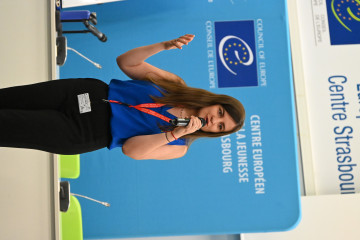
Nevena Radosavljevic
A trainer in peacebuilding and conflict transformation, and a PhD candidate at the Bonn Centre for Reconciliation Studies, and a YPAN member.
مقالات متعلقة