Living Resistance in Israeli Academia
I still remember the moment they walked in. Two colleagues stepped into my office, closed the door behind them, and ambushed me about my political views. It has been six years since then, and although similar ambushes happened afterward, that first one remained the hardest because it was the first time I felt genuinely hunted. People I had coffee with, people whose children I asked about, suddenly felt comfortable dissecting my identity and deciding it was acceptable to attack it. What shocked me most wasn’t the confrontation itself; it was how natural it seemed to them. As if my identity, my presence, my very existence on campus was an open file they had the right to interrogate. And the painful part was knowing this wasn’t unique to me; Palestinian students across the university experienced the same kind of ambushes regularly.
If you were to ask me today about one of the most meaningful roles I have done since I began working at Tel Aviv University in 2019, I would say without hesitation: managing the first-year mentoring program for Arab students at the university. Being part of their academic and professional beginnings was a privilege.
I began my role in April 2021, and that first month was the only quiet one. I redesigned materials, impressed my older colleague with my Canva skills, and we drank coffee on what would later become the staff balcony overlooking demonstrations on campus.
Then came May 2021, when the war on Gaza and attacks on Arabs throughout the country began, and everything changed. A wave of fear and confusion swept through Arab students. Questions about our role as Palestinian staff members inside an Israeli institution became sharper: Were we supposed to calm students? To guide them? To protect them? Or simply stay quiet so we don’t get attacked?
As a Palestinian administrative employee among only around forty in an institution of thousands, I often felt alone. And “alone” didn’t mean there were no other Arab workers. There were; but we were so few, scattered across different departments and often in different buildings. The loneliness showed itself most clearly during lunch breaks. It wasn’t the Hebrew we spoke, as most of us master it by the time we’re professionals. It was the culture, the codes, the world they belonged to. Every lunch, somehow, ended in a conversation about their time serving in the army. That silent internal sign to disconnect politely, to sit still while the conversation entered a space I couldn’t and didn’t want to be part of. These small moments accumulated. Jokes I couldn’t laugh at, comments that reminded me how different my reality was; and left me wondering, what roles my nice colleagues previously held in Israel’s occupation army.
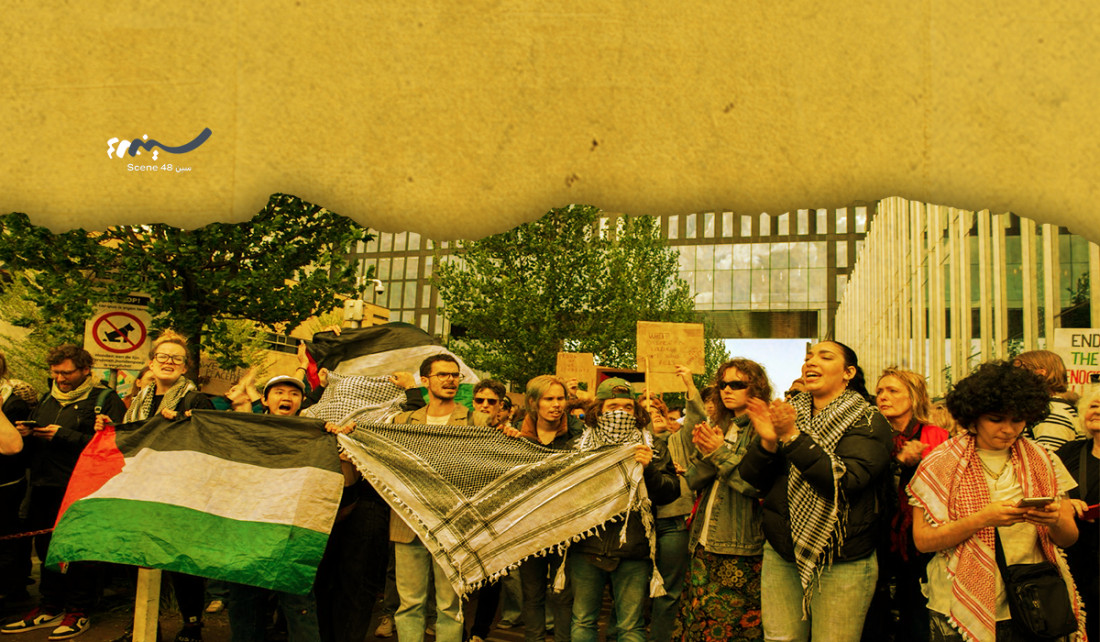
Nakba Day exacerbated my alienation. The office where I worked at that time sits directly above Antin Square right outside campus. I always knew when the ceremony began from the noise outside my window. Palestinian students giving talks about the injustice endured by their grandparents, stories of ethnic cleansing, exile, murdered family members, drowned by the speakers of Israeli protesters blasting Shakira’s “Africa” and other pop hits. I would step out alone, feel the eyes from above, curious and judging, then return to my office as if nothing happened. The silence inside was heavier than the noise outside. It wasn’t just being ignored; it was knowing that at any moment someone could walk in and expect me to explain myself, defend myself, justify my presence, when sometimes all I wanted was to drink my coffee in peace.
Working with first-year students, especially Palestinian students, was never just program management. It was clear that what they needed most was support navigating challenges uniquely tied to our Palestinian identity. Our role as Palestinian staff, Palestinian students’ movements, and Palestinians in academia is to stand beside them, to protect their rights, and to ensure they were not left alone in a campus climate shaped by a dominant Israeli narrative.
Then came October 7, and everything intensified. The gap between our experience as Palestinians and the atmosphere on campus widened painfully, surrounded by soldiers. Palestinian students were scared, cautious, unsure how visible they could be where many of the Israeli students were soldiers allowed to attend university with their guns. Palestinian students would sit next to Israeli students armed in class, scared of expressing their views. The responsibility on us as Palestinian staff inside an Israeli institution became greater than ever.
My own role changed too. Before the war, I often assisted colleagues by delivering workshops to mentor groups, adapting content for both Israeli and Arab cohorts. One of the last workshops I gave was for the Faculty of Medicine. The moment I saw the students (some reservists in uniform) the distance hit me. Standing there, expected to guide them on communication and inclusion, felt impossible. The emotional gap was too wide, the pain too fresh, the air too strange. That workshop was the last I delivered for a Jewish student cohort before leaving my role.
Around the same time, the university opened a centralized complaints system against students. Nearly a hundred complaints poured in, mostly filed against Arab and Palestinian students. It reflected the tense, fearful, painful campus atmosphere. Most complaints were dismissed; only a few lead to disciplinary processes. During these processes, Palestinian student movements and Palestinian staff helped translate, explain cultural context, and defend students.
Witnessing this brought me back to that first ambush years ago. The comfort Israeli students felt when filing complaints resembled the comfort those two colleagues had confronting me. Both situations showed how easily Palestinian futures can be targeted in this institution.
As Palestinians, we cannot enter academia, finish our degrees, and walk out. We must shape and defend our rights, learning conditions, and community support. Whether students active in political movements, volunteers aiding first-year students, or academic and administrative staff, we all have a role within this larger system. A role to influence, protect, sustain our Palestinian identity, and take pride in it as we continue holding each other up.
Beirut Watad
A community projects lead at the Equity, Diversity and Community Commission.
مقالات متعلقة