Strategic Silence: Palestinian Women’s Voices
In the traditional landscape of media and leadership, women are often framed within a narrow binary: they are either tragic victims of conflict or extraordinary heroes who survived it. But between the “impoverished” and the “empowered” lies a vast, sober, and strategically silent territory, one where most women actually live.
For the past two years, as the host of the Shift Ahel podcast, I have sat in this middle ground. I do not come to these conversations as a journalist seeking a headline or an academic analyzing a trend. I come as a witness to the delicate, often invisible negotiation of voice.
In the SWANA region, and specifically within the Palestinian context, the question of who controls what women say is rarely answered by a single authority. Instead, it is shaped by an entire architecture: social expectations, familial protection, internalized fear, and media filters that decide what is “appropriate” to hear and what is easier to dismiss.
Women are taught that their big ideas, their critiques of patriarchy, their claims over their will and freedom, their struggles, their grief, belong in the private sphere. When these ideas attempt to move into public space, they are often required to shrink. Media polices tone. Families fear reputational damage. Leadership reframes systemic critique as personal emotion. This is how structural realities are reduced to small tears. By isolating a woman’s pain, the system strips it of its political and societal meaning.
The Sequence of Breaking Silence
Across more than seventy recorded conversations on Shift Ahel, one pattern repeats itself. Women do not speak impulsively. Their speech follows a quiet, deliberate sequence: Safety. Relief. Courage. Responsibility.
Silence is often a woman’s first line of defense. It functions as a strategic void, used to protect children, preserve relationships, or maintain psychological survival. But when a parallel listening space is created, outside the reach of judgment, correction, or extraction, silence begins to loosen.
Stories of IVF and reproductive struggle, shared by guests such as Fatme Abu Asba and Raneen Marawi Habib, illustrate this shift clearly. In many Arab households, infertility remains a private shame. By bringing the physical, emotional, and systemic realities of repeated rounds of IVF into public hearing, these women reclaim authorship over their bodies. They move from the solitude of home to collective recognition, and in doing so, expose the silence itself as the failure, not the woman.
Similarly, when Shireen Abu Dbai speaks about raising two children with autism, or Manal Freij speaks about mothering through cancer, they are not offering personal updates. They are dismantling the myth of the “effortless mother,” a myth that functions as a disciplinary tool. Their speech emerges at the final stage of the sequence: Responsibility, the realization that silence, if maintained, guarantees the next woman will endure the same isolation.
The Creation of Alternative Networks
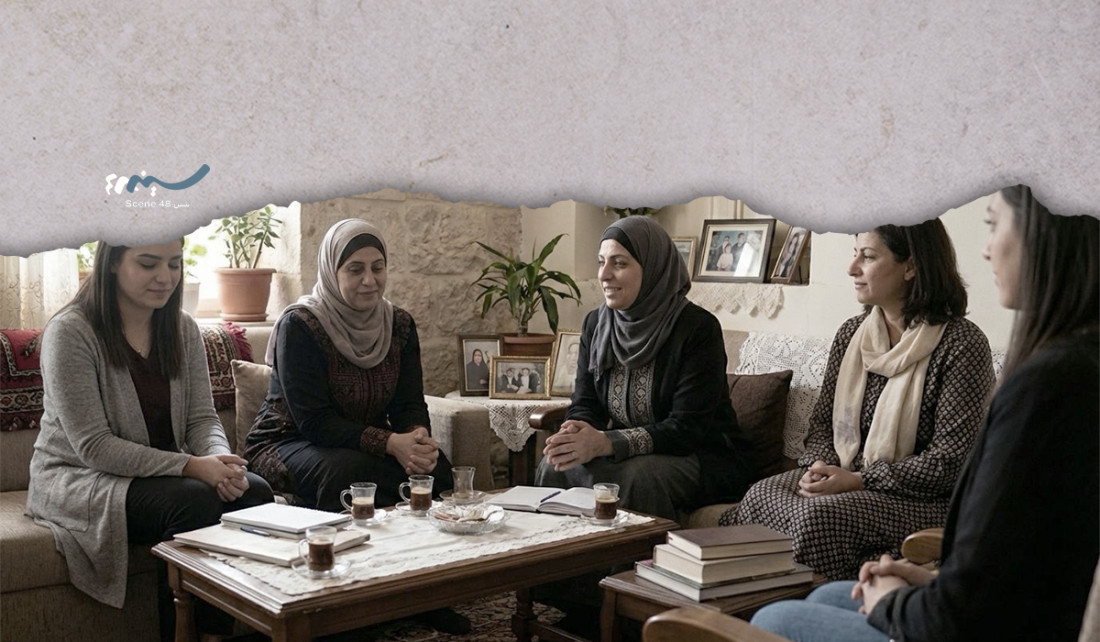
Women have always created parallel systems when official ones excluded them. In the Arab world, resistance did not wait for institutions to grant permission. It lived in the morning coffee gatherings and in women-only “Majlis,” informal, home-based assemblies where women met to exchange stories, advice, poetry, and judgment. These were not merely social rituals; they were early listening infrastructures, places where language could stretch, ideas could circulate, and reputations could be negotiated without formal authority.
Historically, these private rooms functioned as public force. Long before modern media, Arab women hosted literary majālis, transmitted knowledge, and built durable systems of care. Through waqf endowments, women funded water sources, schools, and neighborhood services designed to outlast them. Through teaching circles and ijāza networks, they preserved religious and ethical knowledge across generations. Even large-scale public resilience, from pilgrimage routes to urban welfare, was often sustained through women’s patronage and logistical intelligence. These were not symbolic acts; they were systems engineering under constraint.
What connects these histories to the present is not nostalgia, but method. When access to formal power is blocked, women do not disappear; they reroute. Today, that same logic appears in informal women-only WhatsApp groups, leading to more formal, long-form listening spaces like Shift Ahel. These are not secondary arenas of influence; they are parallel command centers where women decide what can be said, when it is safe to say it, and how much visibility survival allows.
Seen this way, women’s speech has never been only about expression. It has always been about infrastructure.
This lineage is visible in figures such as Fadwa Tuqan, who transformed private confinement and grief into national language without ever performing resistance for approval. It is equally present in Nawal El Saadawi, who insisted that naming the body, pain, and power was not provocation but survival. Both understood what many women intuitively practice today: when formal institutions close, language itself becomes territory.
Digital spaces and long-form podcasts like Shift Ahel are the contemporary extension of these traditions. They function as living archives, places where Palestinian dialect, family nuance, and lived contradiction are preserved without filtration. In these parallel systems, speech is not shaped by political utility or ratings. It is shaped by necessity.
When Hanan Bari chose to speak publicly about her children being taken from her, she was not seeking exposure. She was practicing strategic visibility. By placing her story into the public record, she ensured it could not be erased, reframed, or quietly buried. Her voice became a lighthouse for her children, and for others navigating similar pain.
Silence as a Weapon, not a Weakness
Balance requires that we resist romanticizing speech. Not all silence is submission.
Tactical silence is a form of survival intelligence. In moments of acute familial fracture, women may choose silence to preserve internal sovereignty. This is not the silence of the sidelined, but the silence of the strategist, who understands that words are resources, and timing determines impact.
In my work, I have learned that loudness is not synonymous with resistance, and quiet is not synonymous with defeat. Influence often lives in restraint. It is the mother who waits until her children are safe before telling her story. It is the woman who speaks in a whisper because she knows a whisper can sometimes travel further than a shout.
Beyond the Hero Narrative
We do not need more simplified hero stories. The women who sit in front of the Shift Ahel microphone are not powerful because they are flawless; they are significant because they are real. They operate inside constraint, with agency that is often coded, delayed, or deliberately limited.
The control over women’s voices appears to be shifting, not because institutions have transformed, but because women are no longer waiting for permission to speak. According to a study by Northwestern University in Qatar, 65 percent of women in the Arab world report using independent digital platforms to express opinions on social taboos that traditional media refuses to cover.
Women are building their own spaces. Every time a woman enters a space like Shift Ahel and says, “This is what happened to me,” she is not collapsing into emotion. She is restoring scale to her experience.
The question we are left with is not whether women should speak more, but what would change if we recognized both silence and speech as intelligent strategies, and stopped measuring resistance by volume alone.
Voice is not only about power. It is about meaning. And once a story is shared, it stays, quietly, confidently shaping what comes next.
Besan Abu Abeid
A creator and host of Shift Ahel (Shift أهل), a podcast and cultural archive that documents Palestinian parenting stories and family dynamics. She is a content creator committed to centering Arab voices and enriching the Arabic language in digital spaces.
مقالات متعلقة