You’re Asleep
You’re asleep. Dreaming, perhaps. Through the kaleidoscopic dream, intertwined in it, you hear male voices, crashing doors, babbling geese honking warnings of intruders. Groggily thinking you’re in a nightmare, you awake startled, finding yourself instead in an unreality. A real-life nightmare. Because there, lying in bed next to your husband, you see automatic rifles pointed at you by helmeted, masked men in black.
This happened not long ago to a Palestinian woman friend of mine. Her husband was taken from his bed for questioning about his advocacy, as spokesman for his community, because the authorities want him to shut up. As if demolishing your home TWICE wasn’t enough punishment for his attempt to stop the forcible displacement of an entire East Jerusalem neighborhood, al-Bustan in Silwan, home for generations to some 1500 Palestinians.
Homelessness caused by demolition is such a regular occurrence, it’s hardly newsworthy in Israel, where few Israelis notice the syndrome. Yet this policy didn’t start yesterday. Palestinians in East Jerusalem have been targeted since Israel’s 1967 occupation, at the end of the Six Day War. This, despite its participation in the Geneva Conventions, barring acquisition of land by force, meaning that East Jerusalem and the rest of the West Bank shouldn’t have become part of Israel. Yet in 1980 East Jerusalem was officially annexed, while the rest of the West Bank was eventually formulated into Areas A, B and C under the Oslo Accords. Areas now in the process of full annexation by Israel, despite President Trump’s statements against annexation. De jure or de facto, Israeli military control is increasingly felt everywhere.
We live in days of ‘Golden Calf’ worship of land. The Other automatically cast as an abstract enemy. Demographic threat. File number. To be more easily contained. Controlled. Managed by that diabolical language of automatic weaponry.
And if we go back to 1967-68, when the Israeli authorities zoned the newly configured East Jerusalem, now 70 sq kms instead of the previously small, 6 sq kms urban center (comprising Jerusalem’s Old City and Holy Basin, Silwan, Sheikh Jarrah and the Mount of Olives), we learn that the Israeli intention was always forcible displacement, a war crime. Homelessness. Transfer. Because they only zoned 13 percent of the entire 70 sq kms for Palestinian residential purposes, despite Palestinians representing one third of the city’s entire population at the time. 13 percent that was already fully built up. Meaning that regular home demolitions, under the pretext of “illegal building,” were inevitable, as part of that systematic ethnic transfer. Because Israel never planned to accommodate East Jerusalemites on the open lands they owned.
Today’s eastern part of the city is increasingly Judaised by settlements, whose lands have been grabbed in relentless state expropriation, using state mechanisms, legal maneuvers or contested ownership claims. In Silwan, 3,200 Israeli settlers now live on land for which they mostly have dubious personal claims to title, but with massive funds coming from the Israeli government and Jewish “benefactors” of the diaspora, “philanthropists” whom some would say are assisting Israel to commit suicide. Thus bringing down the Third Temple (which is the modern state) on us. Whilst those who inherited lands, which their grandparents’ grandparents lived on and owned, are under manic attack in a system rigged against them.
Sustained pressure by the authorities invokes: eviction orders, police-protected settler take-overs of neighboring homes, surveillance, armed security guards known as all too trigger happy, hamster-wheel court hearings, or even enforcement to self-demolish as a cheaper version of demolition, no need to pay for police overtime or lunches, or the costs of bulldozers and bobcats.
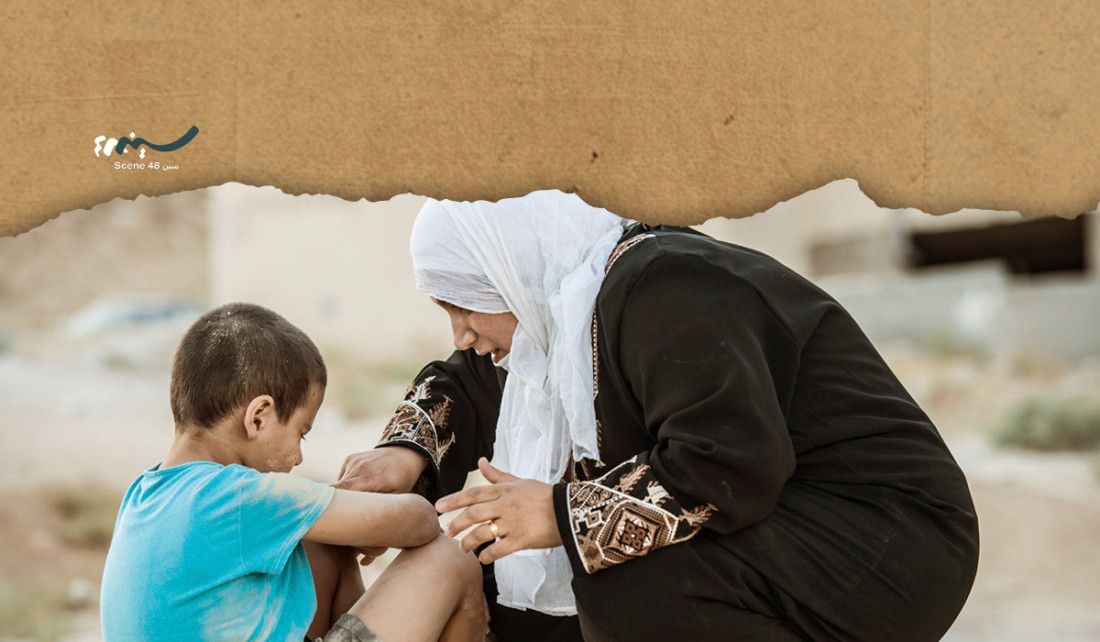
The ongoing homelessness, and statelessness, and chronic instability for East Jerusalemites is most acutely felt by Palestinian women, whose lives revolve around family and home, in this traditionally conservative society, even as they work outside those homes, as teachers, social workers, pharmacists, doctors, lawyers, university professors. The women of Palestine are the intrinsic pillars of their society, despite often having public anonymity, preferring to do their daily social anchoring in low profile. They are the ones, in the hellish aftermath of the machinery of destruction, salvaging precious belongings from the rubble, organizing temporary shelter with relatives, while ensuring the kids continue school attendance. Maintaining rituals, birthdays, weddings, shared meals, even when haunted by this never-ending Nakba.
In al-Bustan, the community’s especially tight-knit. These are extended families (hamulas) who have, for many generations, lived together and often inter-married. And experienced communally the daily abuse of all their human rights. The women are the ones who somehow always manage to deliver hospitality in abundance, despite poverty or crises. They are the ones whose gifts flow almost by magic. Whose hugs convey a history of suffering, a lifetime transcended by caring. Whose humanity puts to shame the lip service of too many of us, as they smile through tears and teach us how not to lose our souls in cynicism, revenge or hatred. Whose giving seems to reflect a mirror image to the Israeli tradition of taking (will we ever overcome our heritage of trauma?). Who continue to serve abundant cups of tea with mint, and fruit peeled especially for you, even while suitcases hover outside their front doors, where bulldozers roam, wildly malicious and ever ravenous.
And to whom would these strong women turn for help? A distant, quixotic US president? Ambassador Huckabee, in occupation denial? International courts that move at archaeological speed? With neither access, leverage nor lobbies (carefully cultivated by Israel and world Jewry over the decades), they point at the skies, putting their faith in God’s natural justice. Believing they have truth on their side, even as they’re relentlessly herded into the ghettos of Kufur Aqab or Shu’afat Refugee Camp, on the wrong side of the Apartheid Wall. Or face the Sisyphean mission of rebuilding. Because when stateless homelessness strikes to the core of these households, the men often take up that burden of rebuilding. So that their wives' tears will cease, and they may be reinstated in their family empire. Hosting grandchildren. At home. Fighting displacement non-violently. Rarely able to relax securely.
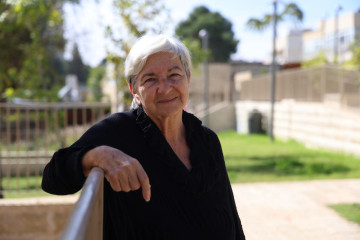
Angela Godfrey-Goldstein
An Anglo-Israeli. Her previous career was in the British theatre, including West End, TV, film and radio drama. She immigrated to Israel in 1981, to study painting with an Israeli (autodidact) teacher, becoming an abstract colourist and tile painter. Living in Sinai for four years as an environmental activist, she organized the saving of Ras Mohammed Marine Park from a Crown of Thorns plague, ran a Bedouin women’s fair trade handicrafts bazaar and ran a tourism magazine in Sharm el Sheikh. A peace activist since 2002, in Jerusalem, she co-directs a Palestinian non-profit: Jahalin Solidarity, whose advocacy works to prevent Palestinian forcible displacement.
مقالات متعلقة