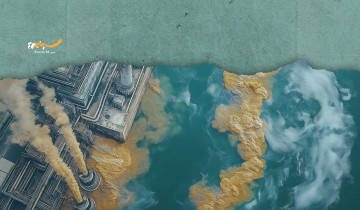
Environmental and Climatic Impacts of War on the Gaza Strip
Contemporary wars are no longer confined to direct military confrontation; they now encompass multiple forms of control and the reconfiguration of place and natural resources in ways that serve political domination. In this context, Gaza stands as a stark example of the complex relationship between war and the environment, where land, resources, and ecological systems become part of the conflict itself rather than merely collateral damage. War in Gaza targets not only human beings, but also water, soil, air, and sea, turning the environment into a battlefield and an instrument for reshaping the conditions of Palestinian life.
The environmental degradation witnessed in the Gaza Strip cannot be understood as a mere accidental consequence of war. Rather, it forms part of a long colonial reality based on control over land, resources, infrastructure, and the daily lives of the population. Modern colonialism relies not only on direct military force, but also on intertwined forms of domination that include control over water, energy, agriculture, and geographic space. The result is a fragile and unstable environment in which sustaining normal life and long-term resilience becomes increasingly difficult.
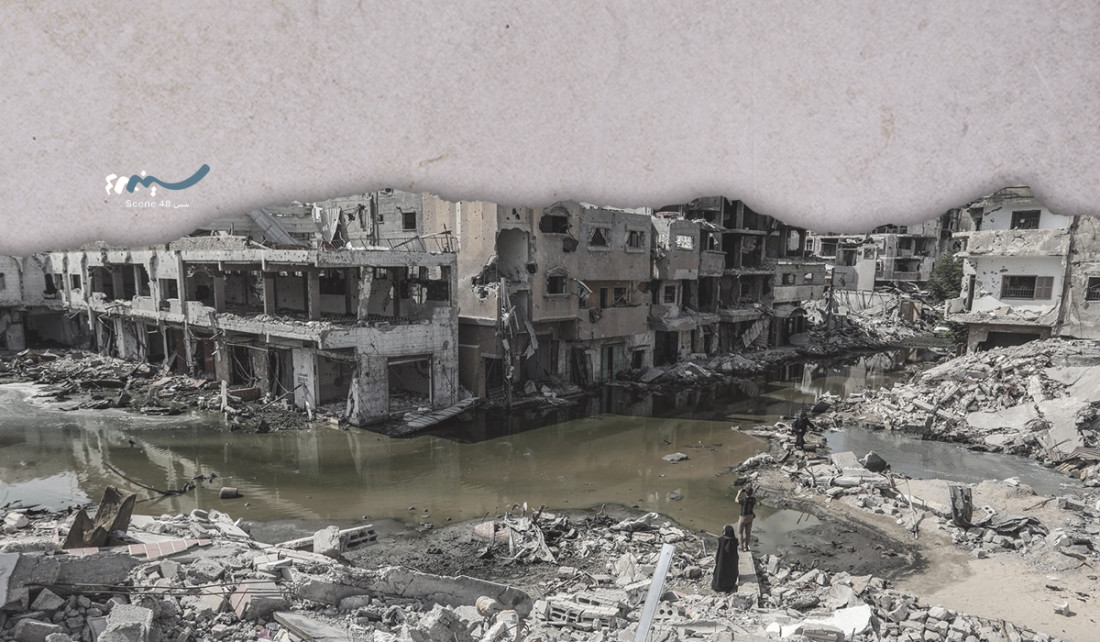
For many years, the Gaza Strip has lived under a comprehensive blockade that has deeply affected the environment and natural resources, even before the outbreak of repeated wars. The blockade has exhausted infrastructure and weakens the territory’s capacity to address environmental crises, especially amid shortages of electricity, fuel, and usable water. As military operations have intensified, destruction has expanded to include water and sewage networks, electricity stations, agricultural land, and vital facilities, leading to an unprecedented worsening of environmental degradation.
Intense bombardment and the use of heavy weaponry have left severe effects on soil, water, and air, through the accumulation of rubble and the leakage of chemicals, sewage, and untreated waste. The destruction and levelling of agricultural land have also reduced vegetation cover and weakened agricultural production, further deepening food insecurity and increasing the population’s economic and environmental vulnerability. In Gaza, land is not merely a geographic area or an economic resource; it is part of identity, memory, and historical continuity. For this reason, the targeting of the environment also constitutes a form of targeting Palestinian existence itself.
The war’s environmental effects have also extended to the sea. The discharge of wastewater and untreated waste has polluted the coastline and the marine environment in the Mediterranean, threatening fish stocks, marine life, and the livelihoods of thousands of Palestinians. At the same time, satellite imagery and geographic information system analyses reveal sharp changes in land use across the Strip, including the contraction of agricultural areas, rising pollution levels, and a decline in vegetation density as a result of war and the ongoing blockade.
The consequences of war are not limited to direct environmental damage; they also extend to the climatic dimension. Bombardment, fires, and the operation of heavy military machinery all increase carbon emissions and worsen air pollution, particularly through rising levels of smoke and fine particles harmful to health. These effects do not remain confined within the geographic boundaries of Gaza, because air pollution and greenhouse gas emissions are inherently transboundary. Smoke from bombardment, fires, and infrastructure destruction, together with emissions from military vehicles and fossil fuel use, does not stay local. It moves through the atmosphere into wider regions under the influence of winds and air currents. These emissions, alongside those generated by wars and military industries globally, contribute to the accumulation of greenhouse gases in the atmosphere, thereby intensifying global warming and accelerating climate change at a worldwide level. For this reason, the environmental impact of war cannot be viewed as a purely local or regional issue. Its climatic consequences affect global ecosystems, including rising temperatures, more frequent extreme weather events, and the disruption of ecological balances in many parts of the world. This reveals that contemporary wars do not merely produce humanitarian and political crises; they also deepen the global climate crisis in ways that transcend borders and sovereignty.
What is happening in Gaza can therefore be understood through the concept of environmental violence, which refers to the use of environmental destruction in ways that exhaust society and weaken its ability to survive and continue. The targeting of water, energy, agriculture, and ecological infrastructure is no less serious than the targeting of people, because it strikes at the conditions of life itself and creates long-term crises related to health, food, and social stability. This is also connected to what is often described as ecological colonialism, in which control over natural resources and environmental systems becomes a means of reproducing domination and subjugating populations.
Despite growing international interest in the relationship between armed conflict and environmental change, the Palestinian case is still often discussed within humanitarian or political frameworks that are detached from its environmental dimension. Much international discourse treats environmental deterioration in Gaza as a technical or emergency humanitarian crisis, without linking it to the political and colonial structures that produce and continually intensify this deterioration.
The war on Gaza also reveals a clear contradiction within the global climate system. States involved in military industries or supportive of wars participate in international conferences on climate and environmental protection, while the military policies and wars themselves destroy ecosystems and increase pollution and carbon emissions. This exposes a serious crisis in the meaning of global climate justice, since climate change is often treated as a technical issue limited to energy and emissions, while the vast environmental costs of militarization, war, and colonial domination are ignored.
In Gaza, this contradiction is especially visible, because the environment becomes part of the conflict system itself rather than a neutral space suffering incidental damage. Environmental destruction is inseparable from policies of control and subjugation; indeed, it is one of their principal forms. For this reason, any discussion of Gaza’s reconstruction should not be limited to rebuilding buildings and restoring services. It must also include environmental rehabilitation, protection of natural resources, and the guarantee of environmental justice as a fundamental part of the Palestinian right to life, stability, and continuity.
Dr. Somaya Falah
An environmental engineer and researcher specializing in atmospheric aerosols, air pollution, climate change, and satellite remote sensing. Her work focuses on PM2.5 exposure assessment, aerosol–climate interactions, and machine learning applications in environmental science. She has expertise integrating satellite and ground-based observations for air quality and climate studies. Before earning her Ph.D., she completed degrees in chemistry, science education, and environmental sciences, building a strong multidisciplinary foundation in environmental and engineering sciences.
Related Articles