Who Holds the Permission, Holds the Politics
By late 2024, a Palestinian woman in Gaza was three times more likely to die in childbirth than before the war, and three times more likely to miscarry, per the UN Human Rights Office.[1] That December, an Israeli strike hit Gaza’s largest fertility clinic, destroying more than 4,000 embryos and over 1,000 sperm and egg specimens: the reproductive future of hundreds of families, gone without warning.[1] In September 2025, the UN’s Independent International Commission of Inquiry concluded that Israel had committed genocide against Palestinians in Gaza, citing the deliberate imposition of conditions intended to prevent births.[2] A woman whose fertility and survival are controlled by someone else’s military calculus has already had her political voice decided for her, long before she reaches a ballot box.
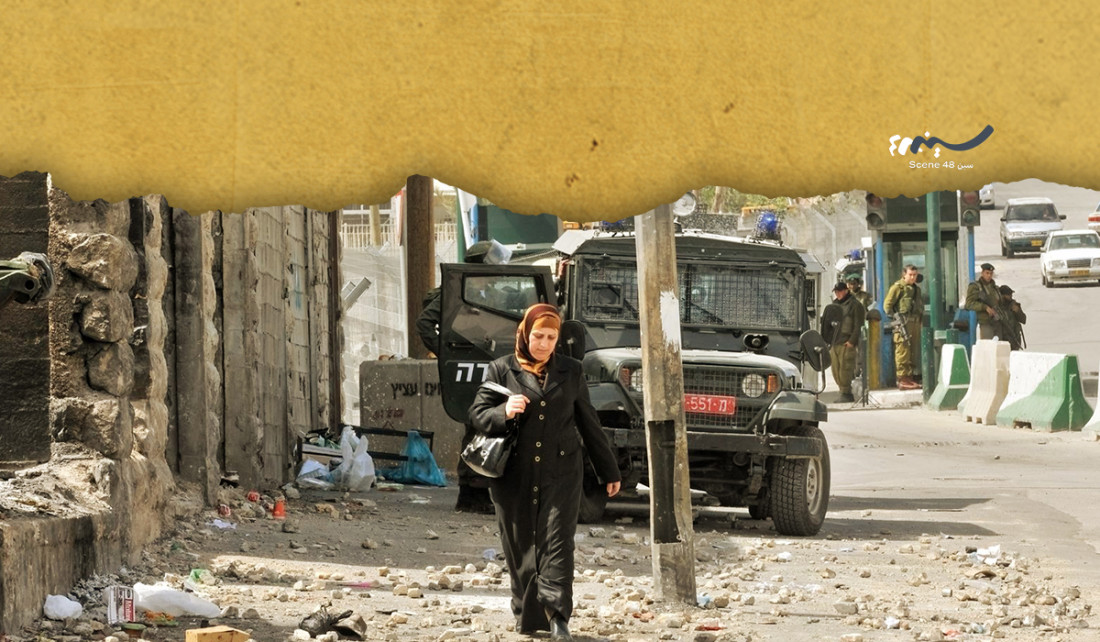
The West Bank tells the same story, minus the bombs. Since October 2023, Israel has revoked most permits letting Palestinians cross into Jerusalem and Israel. By December 2025, OCHA counted 925 obstacles strangling movement across the territory, the most in twenty years and 43 percent more than usual, choking 3.4 million Palestinians.[3] This is politics with a capital P: soldiers at a barrier deciding who reaches a meeting, a campaign visit, a polling station.
The permission regime also decides whether a woman keeps the future she already built. Kholoud Abu Sahmoud, a university professor from Gaza, finished a master’s in a year and four months, then earned a doctorate. Displaced repeatedly, she was displaced again by her own body when doctors found liver cancer after her youngest child’s birth, and now lives beneath a school stairwell in Khan Younis.[4] Doctors said she could not continue chemotherapy, since the drugs in Gaza were not suitable, and her approved referral abroad has sat unused for months because she cannot get out.[4] Kholoud is not short on will. She is short on permission.
The same logic reaches education. In 2026, four sisters from Rafah, Taqwa, Yaqeen, Ihsan, and Eiman Shabana, outstanding university students, were killed by an Israeli F-16 strike while displaced in Khan Younis.[5] Rescue crews buried their remains in one grave alongside their mother and brother, killed in the same strike.[5] Known online as “the doctors of tomorrow,” they never touched a stethoscope.[6] The four sisters join more than 193 academics and 830 teachers killed in strikes over the course of the war.[7]
The permission regime reaches even past death. Families unable to bury their dead under Israeli siege and sniper fire sometimes preserved bodies in solar-powered refrigerators to avoid witnessing decomposition.[8] Al Jazeera documented the case of Sa‘ida Abdul Hadi al-Za‘anin, shot by a sniper while hanging laundry on her balcony; with ambulances unable to reach her, she died half an hour later.[8] Her husband placed her body in the refrigerator, and for six days, her nine children knocked on the door, calling for their mother.[8] The siege that controlled Sa‘ida's life controlled her death, too.
No framework built from outside that refrigerator door could have measured what Sa‘ida’s family lost. Stories like hers, the four sisters’, or Kholoud’s don’t show up in the official accounting. The language of “inclusive processes” treats the problem as a seating chart rather than the absence of self-determination itself: you cannot include a people in decisions about a land they cannot move across, a hospital they cannot reach, a future they may not live to see. The gate doesn’t change. Only what it’s blocking does.
That same obsession with seating shows up in the quota reserving roughly one in five Palestinian municipal council seats for women, and in the international Women, Peace and Security frame, which splits “protection” from “participation,” thus treating survival as background while measuring “participation” only in seats. Representation is not nothing, and that case deserves to be taken seriously. But presence in the room assumes the room itself is reachable, on terms not set by a checkpoint. A seat that can be revoked by a closed gate, a canceled evacuation, a denied permit, is a seat on loan, not a real one.
Palestinian women are not short on the capacity to lead, negotiate, govern, teach, or heal. They are short on being permitted to arrive: at a council chamber, a hospital abroad, a doctorate’s finish line, a grave. The daily negotiation with armed power that Palestinian women conduct without ever occupying a counted seat is already political life, unrecognized because recognition was never going to come from the authority that built the checkpoint, denied the evacuation, or closed the road to burial.
Recognition doesn’t have to wait on a checkpoint’s permission. Over the course of this war and genocide, I collected more than 2,000 online accounts by Palestinian women documenting survival, resistance, and visions for peace, most still waiting to be translated and heard. This archive is proof that recognition can be built, account by account, by the people the official record left out.
Self-determination was never a choice offered from someone else’s menu. It is the right to arrive, uninvited if necessary, at the place where choices are made, and to build a different table when the old road is closed. It is also, more simply, the right to have a future worth arriving at, and to live long enough to reach it. Every count of women’s seats or leadership roles that doesn’t ask who could reach them isn’t measuring political participation. It’s measuring how far a policy document sits from the women it describes.
Sources
[1] OHCHR, reported in “Gaza’s maternal and newborn health system ‘decimated’, UN warns,” UN News, December 11–12, 2025.
https://news.un.org/en/story/2025/12/1166569
[2] UN Independent International Commission of Inquiry on the Occupied Palestinian Territory, September 16, 2025, finding reasonable grounds that Israel committed genocide against Palestinians in Gaza. Israel's government has rejected the Commission's findings as “distorted and false.”
[3] OCHA, “Fact Sheet: Movement and Access in the West Bank,” April 2026, based on a December 2025 field survey.
[4] “‘I am dying slowly’: Gaza professor blocked from cancer treatment by Israel’s siege,” Middle East Eye, 2026.
[5] أربع شقيقات تحولن لأشلاء.. إسرائيل تدفن طموح تقوى ويقين وإحسان وإيمان في قبر واحد (“Four sisters turned to fragments: Israel buries the ambitions of Taqwa, Yaqeen, Ihsan, and Eiman in a single grave”), Al-Watan News, 2026.
https://www.elwatannews.com/news/details/8319658
[6] اغتيال طبيبات الغد.. استشهاد الشقيقات الأربع تشعل منصات التواصل (“The assassination of ‘tomorrow’s doctors’: the martyrdom of the four sisters ignites social media”), Sawaleif, 2026; and Arab Telegraph, 2026.
https://sawaleif.com/اغتيال-طبيبات-الغد-استشهاد-الشقيقات-الأربع-1091485/
https://www.arabtelegraph.com/?p=240538
[7] Euro-Med Human Rights Monitor, reported in “Israel: an educational genocide in Gaza, in numbers,” The Canary, September 7, 2025.
https://www.thecanary.co/global/world-analysis/2025/09/07/israel-education-gaza/
[8] في ثلاجة وأمام مروحة.. هكذا حفظ محاصرون جثامين شهدائهم في حرب غزة (“In a refrigerator and in front of a fan: how the besieged preserved the bodies of their martyrs in the Gaza war”), Al Jazeera Net, June 26, 2026.
https://www.aljazeera.net/politics/2026/6/26/غزة-فلسطين-احتلال-إسرائيل-جثامين
Dr. Nida Shoughry
A political analyst and multilingual researcher-activist specializing in feminist approaches to peace, conflict, and political mobilization, challenging dominant frameworks in international politics. She holds a PhD in International Politics and a Master’s in Broadcast Journalism.
Related Articles