Giving Syrian Women’s Rage a Stage
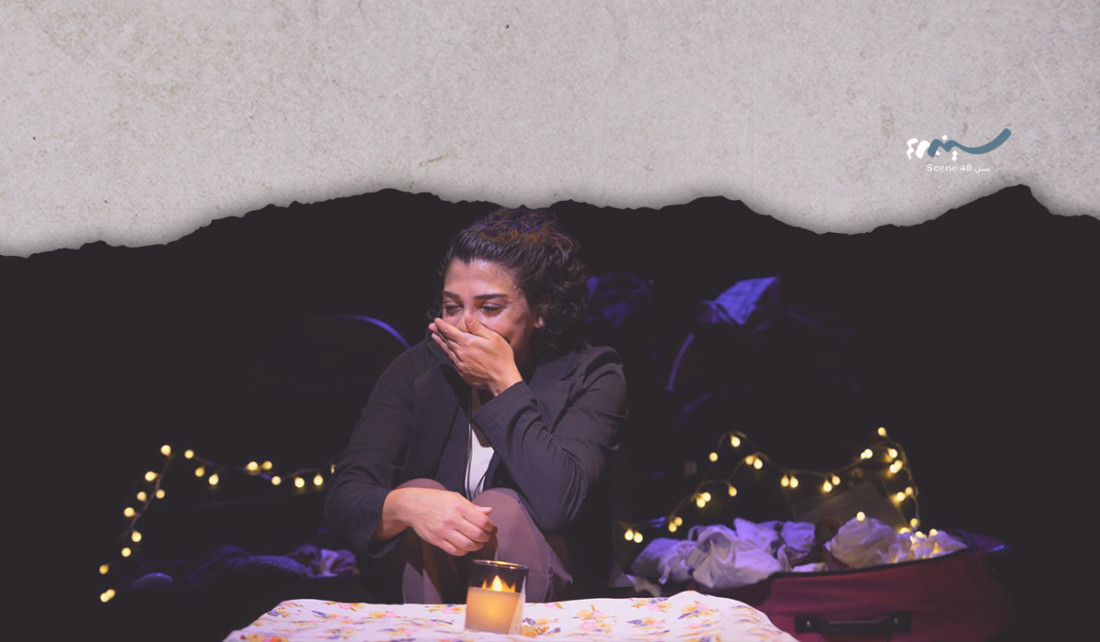
Almost ten years ago, I met Lekaa Sharaf on a stairway outside our first acting class at the University of Haifa. We performed in our first university play together, a reworking of Ghassan Kanafani’s The Little Lantern. Ever since, whenever I have seen her create, write, or perform, she has brought her Syrian feminist identity to the stage. Ancestral Rage is Lekaa’s most recent theatrical production, co-written and directed by performer Masha Simaan.
In this play, Lekaa not only brings herself to the stage but also introduces us to her grandmothers: Hanaa, Saneya, Hafetha, and Fatimah. These characters enter our lives through a chorus of voices and subtitles. We hear their voices and their Syrian dialect, while their words appear on a screen behind the performer. Each character is assigned a different color, distinguishing her words and presence from those of the others.
 |
|---|
Let’s Talk About the Beginning
The first mise-en-scène of the performance presents us with an actress waiting on an orange bench. At first glance, we might think she is waiting for a bus. But Lekaa Sharaf, born in 1997, is part of a generation waiting for a plane, for an opportunity to perform in Berlin or elsewhere in Europe, at least as her character on stage tells us. Ancestral Rage raises questions about this generation’s relationship with its ancestors, as well as the questions we have never dared to ask them. Ancestral Rage is a documentary monodrama, a play with a single performer, created as an act of uprising. The orange chairs seem to symbolize the dreams we keep postponing, the dreams we have never fulfilled but continue to imagine and hope to achieve, even though we do not know whether they will ever come true or, as Lekaa says, whether they might turn into nightmares.
 |
|---|
Grandma, What Are We?
In this play, the difference between Lekaa, the grandchild, and her grandmothers is also shaped by the political reality of the Syrian al-Joulan Heights. Occupied in 1967, the Syrian al-Joulan Heights left thousands of Druze Syrians stateless, caught between the new reality imposed by the Israeli occupation and a homeland behind the fence. This is a reality that many young people have had to navigate. For Lekaa, it also shaped her dream of studying acting at the Higher Institute of Dramatic Arts in Damascus, a dream that became impossible to pursue after 2011, when al-Joulan Syrians studying in Damascus had to choose between returning to the occupied al-Joulan or staying in Damascus and risking never being reunited with their families.
Lekaa brings these dreams, questions, and fears into her monodrama. Throughout the play, she moves between several distinct voices. One is Lekaa herself, talking to herself and to the audience. Another emerges when Lekaa speaks to her grandmothers, as her voice becomes softer and a bit childish. There is also the voice of her criticizer, whom we see in a different outfit and under red lighting on the stage. She introduces this figure as “her devil,” pushing her to be selfish, to disconnect from her heritage, and, as a stateless person, to get an Israeli passport.
 |
|---|
Alongside these voices are the unique voices of each of the grandmothers. The music and sound production, created by Lekaa’s partner, Syrian musician Amr Madah, add another layer of depth to the play. Every time Lekaa speaks about this place, she says “the occupied Joulan Heights,” a place whose very name cannot be simplified, let alone the experience of living in it.
The play has been performed in Majdal Shams, Haifa, Jaffa, Ramallah, Jerusalem, and Amman. Yet I found myself asking specifically about the performance in Majdal Shams. Lekaa said:
“There was a sense of collective catharsis, a feeling that we were all in this together. The audience would laugh, and I felt like they already knew what I was going to say before I even said it. That was very moving. The performances in other places were actually surprising. In every place, the audience was different, and they saw and experienced the work in a different way.”
Untold Stories
Lekaa says that, as she was interviewing her grandmothers, she would hear stories about their everyday lives, and all of their stories turned out to be political, about repression and how they tried to navigate these systems, how they lived and supported each other. “I found out that we do have sources of strength and hope in this heritage, and it was important to me to bring it back so I could understand how I can survive myself, as someone who lives here. I wanted to relearn these tools so I could survive. This work was written during the start of the Gaza genocide, and I needed any thread of hope, anything that could make me feel that I’m not going to die. And Grandma was this for me.”
Lekaa mentions that what distinguishes her grandmothers is that they talk less and do more. When asked why she decided to document her grandmothers rather than her mother or aunts, she says:
“I actually did an interview with my mother to see the difference between the way my grandmother speaks and the way my mother speaks. My mother, for example, used many academic terms to describe the occupation, resistance, liberation, and other concepts that we later learn to use to describe what we are going through. My grandmother, on the other hand, expressed everything she believed in through her actions, without slogans. She would talk about her relationship with the land, how she cultivated it, how she interacted with her neighbors, what she cooked during the strike, how she fed her children, and how she would ask about those who were absent. All of these actions seemed to translate her values and principles into everyday practices.”
 |
|---|
Lekaa continues to describe how her grandmother’s story was never told. She is not considered one of the pioneering political women in the community, yet, at the same time, “she is one of the strongest and most political people I know, and she has abilities that I admire.”
“I had the desire to reclaim this,” Lekaa says. “This is what I described as rage. I want to be like my grandmother. I want to be able to tell stories the way she does and to keep my relationship with the land like she does. I want to be able to be angry at a soldier at the checkpoint the way she does.”
To Dare to Say No
During the performance, Lekaa raises the question, “Why doesn’t my ‘no’ work like my grandma’s?” This question brings us to the reality we live in as a generation that does not have a sense of belonging to the place where we live, but perhaps to the symbol of it. Lekaa says that she knows Al Sham by heart through the stories her grandmother told her, yet she has never actually been there. Her grandmothers’ voices represent the voice of freedom. The way they speak is brief and direct, holding few details but offering clear, short statements, for example: “The wind turbine project is not good at all.”
Another motif that is present at both the beginning and the end of the play is hunger. This motif is not a coincidence considering the time in which the play was written, when thousands of people were experiencing famine in Gaza. In addition, hunger may carry a metaphorical meaning, representing a hunger for life, for knowing what the next step is, and for the moment when a person stops asking herself whether she should leave or not.
Ancestral Rage brings the here and now to the stage through the use of the present tense, describing something as if it is happening at that very moment. This is something that distinguishes it from other monodramas and allows the audience to experience the moment alongside the performer.
To Choose Anyway
When I asked Lekaa about the documentation process itself and whether there was anything she found strange, she said: “The strangest, and also the saddest and most painful, thing was that in one of the interviews, one of the women I documented spoke about the killing of Ghali Farhat, who was her mother-in-law. [...] She had actually been with Ghali Farhat when she was killed, so she described exactly what happened. Ironically, no one had ever asked her for her testimony, even though she was the person who had been there with her. [...] This was the first time anyone had recorded her testimony or interviewed her about the event. It was incredibly painful because, as she was speaking, you could suddenly see her eyes widen and her speech become more difficult. There was something very clearly still alive in her, even though we were talking about an event that happened in the 1980s. [...] In the end, we decided not to include it in the work. You could almost see the event as she was describing it. I didn’t want it to be triggering, especially given the reality we are living in now and how difficult and complicated it already is.”
Photo Credit: Timour Salameh.
Abeer Bashtawi
A multidisciplinary artist, freelance journalist, and M.A. researcher exploring monodrama and solo movement theater through interdisciplinary methodologies that integrate artistic practice and social science research.
Related Articles