Do Arabs Wear Red?

Heart disease kills more women than any other condition worldwide. It causes about one in three female deaths, affecting roughly 275 million women with 6,400 cases per hundred thousand. Yet women’s heart issues are often missed or mistreated.
Symptoms differ for women compared to men. Chest pain may be absent more often, and women more frequently report symptoms like shortness of breath, fatigue, nausea, and sleep disturbance. This leads to delays in diagnosis. Accordingly, women get fewer tests, drugs, or rehab programs. This stems from the core cause, among others, that women remain underrepresented in many cardiovascular trials, particularly in coronary and heart failure research. This limits sex-specific evidence. In some interventional and acute coronary studies, women have comprised as little as 20–25 percent of participants.
Globally, progress is underway but slow
Progress is underway worldwide, but it is slow. Campaigns like the American Heart Association’s Go Red for Women and World Heart Day raise awareness about risks like high blood pressure and diabetes. Europe’s Heart Network runs women-focused screenings.
As part of Go Red campaigns, many companies, institutions, and associations engage women and men in wearing red at work and in public. This makes bold statements not only for awareness, but for the critical actions needed to make a change.
The Lancet1, a prestigious medical journal, sets a bold 2030 target: reduce the global burden through better prevention, research, diagnosis, and care.
Arab Countries tell a grimmer story
Arab countries tell a grimmer story. The North Africa and Middle East (NAME) region ranks among the world’s top three for women’s heart disease rates, along with Eastern Europe and Central Asia. Age-adjusted mortality hits 340 per hundred thousand women (two to more than three times higher than North America and Western Europe, and 67 percent higher than the global average). There are 934 incident cases per hundred thousand (triple that of Western Europe, double that of North America, and 46 percent higher than the global average). Ischemic heart (coronary artery) disease alone led to 0.8 million deaths and 18 million years of healthy life lost in 2019.
Women here often face heart attacks younger than in the West, with more diabetes and obesity. Yet they receive fewer stents, statins, or rehab than men, resulting in higher death rates and poorer recovery.
Subregions show stark patterns. In the Levant, the burden is crushing. Although males have higher age-standardized disease disability-adjusted life years (DALYs) and mortality rates than females, female numbers are significantly higher than those for western females. Syria’s female DALYs are 8,540 per hundred thousand; Lebanon’s are 4,487 per hundred thousand. Females also contribute a large absolute burden and higher proportions of premature deaths. Palestinian women in Jerusalem suffer 2.4 times more acute heart events than Jewish women there.
The Gulf sees exploding cases. Women’s new diagnoses rose 521 percent in the UAE and 475 percent in Qatar since 1990. Qatar’s mortality is 207 per hundred thousand, fueled by sky-high diabetes in women. The Maghreb fares poorly too.
Do Arabs wear red?
Despite these striking statistics, awareness campaigns and action plans lag badly. There were sporadic activities, such as the “Feel the Beat” campaign in collaboration with Majid Al Futtaim mall chain. It brought screenings on World Heart Day to Gulf malls, aiming to teach women their risks. In addition, WHO’s Eastern Mediterranean office pushes heart health. However, no current Arab equivalent to Go Red exists. There are no sustained media ads, women-only clinics, or massive research pushes. No bold national or multinational awareness campaigns have been adopted today by companies, associations, institutions, or societies.
In conclusion, very few wear red, if any.
Why the Crisis?
Rapid urbanization boosts obesity and diabetes, while low awareness ignores women’s subtle symptoms and research overlooks Arab women. Conflicts, occupation, and wars disrupt care, making people busy with hectic trials of survival. They fear a stray bullet, hide from a missile shower, combat a systematic protection racket threat, and fight ethnic cleansing. Political reality has a great influence on healthcare. Why would one prioritize his or her heart’s health, while political factors and propaganda are killing it anyway?
Having said that, a better and more hopeful future is what one should hold his breath for. Opportunities abound. Adopt Go Red locally and on a national level through Arabic media. Roll out mobile screenings. Train staff on sex differences. Include more women in trials and research, and create persistent demands for change. Arab healthcare and policymaking leaders can partner with WHO and Lancet goals to save millions of healthy years.
It is the statistics’ call to action, women’s call to action, and my call to action: to step boldly and make a difference by running Arab campaigns. This could mean joining Go Red and dressing up in red, or creating our own campaigns and branding to actively raise awareness and put together a taskforce to alter the status quo.
But it isn’t about the colors we wear, is it?
But it isn't about the colors we wear, is it? In an ideal world, governments, leaders, and people in power are busy enabling a future where safety, equality, quality of life, and healthcare are among the basic values and rights. In such a world, color would just refer to style, tone matching, and mood.
Yet in the terrifying world we live in, every color matters. Each color is a symbolic movement of people standing for their basic rights, taking over responsibility to secure the lives and future of their own and their families: to live safely, healthy, and in pride.
We Palestinians of 1948, for example, are filling up our wardrobes with colors, each for a critical cause. Wear pink for cancer-free. Wear black to stop violence against women. Wear blue to fight diabetes in children. We had to start wearing cyan to “Stop The Crime Now.” Red would be the next color to wear, calling on us to save women’s hearts.
What we were raised to understand as a pack of colored pencils to color the flowers, skies, sun, and birds we drew now has life-or-death meaning.
I choose life. That is why I close with a famous quote we Arabs believe in, adopt, and chant in every ordeal:
“If, one day, the people will to live,
Then fate must obey.
Darkness must dissipate,
And the shackles must break.”
—by Tunisian poet Abu Al-Qasim Al-Shabbi.
May fate obey, and may equality and justice find their way into our world. It has been very dark recently. Look after yourself, as no one else will.
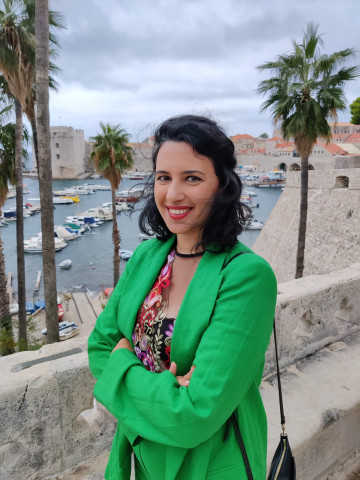
Dr. Hanan Khamis
An engineer and a social entrepreneur.
Related Articles