The Good-Enough Palestinian Mother: From the Nakba to Gaza
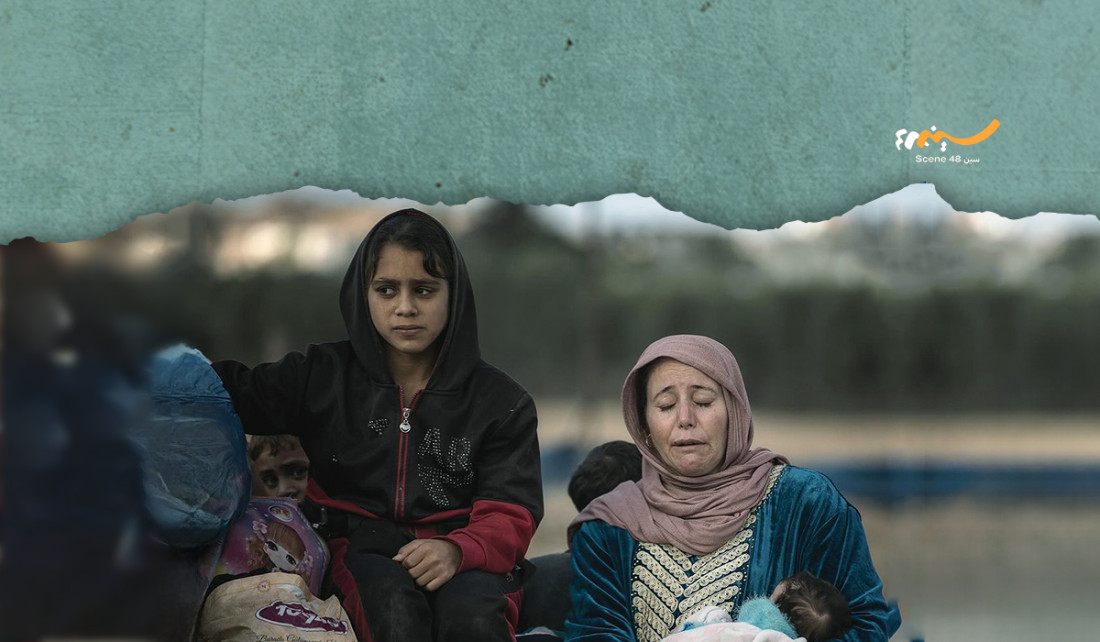
Did you hear about the mother who, fleeing the Nakba, grabbed the black blanket and left her newborn behind? Did you hear about the mother who, in her fear, forgot her child at home? I heard dozens of such stories from refugees in the camps, stories of fractured mothering, recounted with a painful familiarity. Each revealed how displacement can enter the most intimate dimensions of mothering, disrupting even its most instinctive acts of care.
Seventy-six years later, I sat with an eight-year-old girl in a refugee camp in the West Bank who pointed toward a horizon she had never crossed. “Is the camp bigger than the sea?” she asked. I had no answer. The question has stayed with me because it was never simply about geography. It was a child trying to measure the world she had been given against a world she had only heard about. In that gap, I began to understand what it means to mother, and to be a child, under a system that continually narrows the conditions of both.
The blanket, the forgotten child, and the girl’s question belong to the same history. Since the Nakba, Palestinian mothers have carried a double burden that dominant theories of motherhood struggle to name. They experience violence as women under settler colonialism: violence that reaches their bodies, movement, homes, land, and reproductive lives. At the same time, they mother children whose childhoods are shaped by displacement, military control, violence, and insecurity. These are not separate hardships. They are interconnected dimensions of the same colonial condition.
Scholarship on Indigenous motherhood under colonialism helps illuminate how colonial power reaches into the intimate sphere of family life. Colonial systems do not only seize land and political authority; they also seek to reorganize relationships, undermine women’s authority, and impose external definitions of legitimate motherhood and childhood. In Palestine, this logic is material. Palestinian women mother within conditions shaped by checkpoints, restrictions on movement, residency regimes, home demolitions, and the continual threat of displacement. The ability to provide stability is therefore never simply a matter of individual maternal capacity.
Alongside this is the systematic violence directed at Palestinian children. Children are killed, injured, detained, displaced, denied medical care, and deprived of ordinary spaces of learning and play. Their childhood is repeatedly interrupted and constrained. I use the term unchilding briefly here to name this process: the erosion of the protections, security, and recognition conventionally associated with childhood.
This context also forces us to reconsider the Western psychological ideal of the “good-enough mother.” The concept generally assumes that a mother can provide sufficient safety, consistency, emotional availability, and protection for a child to develop. But what happens when the conditions that make such mothering possible are systematically taken away? What does it mean to be a “good-enough” mother when a home can be demolished, a refugee camp raided, movement restricted, medical care denied, or, in Gaza, a family forced repeatedly to flee bombardment?
Palestinian mothers expose the limits of a model that treats mothering primarily as an individual capacity rather than a practice shaped by political and material conditions. A mother cannot guarantee safety when safety itself has been made impossible. She cannot provide continuity when displacement repeatedly destroys the places, routines, and relationships through which continuity is produced. Yet mothering does not disappear. Mothers create fragments of safety from what remains: finding food and water, making temporary shelter feel like home, holding a frightened child, answering questions, maintaining routines, telling stories, and creating moments in which a child can still play, imagine, and hope.
We can see this most devastatingly in Gaza, where mothers continue to perform the ordinary work of caring for children amid extraordinary conditions. They feed, comfort, protect, search, carry, and improvise while the material foundations of ordinary family life are repeatedly destroyed. These acts may appear ordinary, but under such conditions they become deeply political. They insist that mothering remains possible even when the conditions for it have been systematically dismantled.
Perhaps this is what Palestinian mothers teach us about being a “good-enough” mother. Mothering cannot be judged apart from the conditions in which it takes place. When safety, stability, home, movement, and the possibility of a future are systematically denied, the demand that a mother provide them as though they were within her individual control becomes itself a form of violence. Yet mothers continue to create what they can from what remains. They make shelter where there is no home, routine where there is disruption, comfort where there is fear, and possibility where the future has been narrowed.
So when I think back to that girl’s question, I no longer hear only a child confused about distance. I hear the outline of what a system that targets both women and children does to a family: it draws the boundaries of their world so tightly that the sea, something as ordinary as open water, becomes an abstraction, almost a myth. And underneath her question, I hear the quieter labor of mothers who try, every day, to answer without breaking the child who is asking: yes, there is a sea; yes, it is real; yes, you will see it.
The mother fleeing the Nakba and the mother sheltering her child in Gaza are separated by generations, but they inhabit the same colonial history. One ran from a home that had ceased to be safe; the other mothers amid the destruction of homes themselves. Between them lies a history of displacement, dispossession, and interrupted childhood. Yet there is also continuity in what mothers do. They carry, search, feed, hold, comfort, remember, and imagine. When a mother tells her child that the sea is real, that it exists beyond the boundaries of the camp, beyond the ruins, beyond the horizon they cannot yet reach, she is doing more than answering a question. She is keeping a future alive.
Photo credit: Motaz Azaiza.
Dr. Rawan Nasser
Holds a PhD in Social Work and Social Welfare and is a Research Fellow at University College London (UCL). Her research focuses on Palestinian childhood, refugees and displacement, ongoing colonial violence, and the production of Indigenous knowledge, with a particular interest in centering children’s voices, experiences, and forms of refusal
Related Articles