When the Checkpoint Enters the Room
In Tel Rumeida, politics begins before anyone reaches the meeting table. It begins on stone steps where residents move under the gaze of soldiers and surveillance cameras. It passes through electronic gates and narrow streets, where thyme drifting from balconies mingles with gun oil and the metallic sound of barriers. Daily life unfolds at the intersection of two systems of power: the military regime imposed by the Israeli occupation and conservative social and clan-based structures shaping gender roles, authority, and access to decision-making. Within this landscape, Houria Emraish has built her practice as a community mediator.
Her story reveals how political agency develops inside homes, in the women’s section of a mosque, around family tables, and within customary reconciliation councils. Houria connects small “p” politics, the right to speak, choose, and negotiate within the self and the family, with Big “P” politics, the authority to enter male-dominated spaces and shape collective decisions.
Cynthia Enloe’s feminist reading of international politics shows how structures described as private remain deeply political. Decisions concerning marriage, inheritance, family roles, dignity, and voice reflect wider relations of power. Houria brings the right to decide into spaces where power is experienced most intimately, transforming self-determination from an abstract principle into an everyday practice.
Physiotherapy taught Houria to read the body: a raised shoulder may signal caution, a restless foot anxiety, and a deep breath openness to a new idea. Studies in Islamic law and ethics grounded her approach in justice, compassion, and dignity, while education and first-aid training strengthened her clarity and composure in moments of crisis.
She brought these forms of knowledge together in the “Mediation Notebook.” Its numbered pages contain a session plan, open-ended questions, a map of the conflict, and space for details formal records often overlook: a trembling hand, a shift in tone, an exchanged glance, or a meaningful silence. The notebook turns mediation into a disciplined practice of listening, interpretation, documentation, follow-up, and accountability.
 |
|---|
Houria’s work can be understood as bargaining with patriarchy, if to were put in Deniz Kandiyoti’s terms. She operates through the values, language, and institutions of her community while gradually shifting authority within them. Her legitimacy emerges from professional competence, ethical consistency, and her capacity to produce fair and workable outcomes.
In the fall of 2019, Houria mediated between a married couple approaching separation. Years of unresolved frustration shaped every sentence. The outcome extended beyond preserving a household. It created a space in which both parties could help define the terms of their shared life. Mediation became an exercise in the right to decide.
A year later, Houria met in a mosque’s women’s section with a divorced, pregnant woman facing family pressure and an uncertain future. She asked her to write three sentences: her deepest desire, the boundary protecting her dignity, and the future she envisioned for her child. Those sentences became a map of agency, guiding decisions about health care, legal support, family communication, and a network of women able to stand beside her. The woman’s voice became the starting point of the process, and her future became something she possessed the right and capacity to shape.
The renowned anthropologist Saba Mahmood’s understanding of agency is particularly relevant here. Agency appears as the capacity to act from within lived social and cultural frameworks, using available values and languages to create new possibilities. Houria works through the community’s moral vocabulary while expanding the space available for women’s choice, dignity, and participation.
Her work also contributes to community resilience. Johan Galtung distinguishes between negative peace, the cessation of direct violence, and positive peace, built through justice, balanced relationships, and stronger social structures. In Tel Rumeida, structural violence affects movement, security, livelihoods, and daily relationships. When Houria resolves disputes between families who share checkpoints and narrow streets, she protects the social fabric from further erosion. Peacebuilding becomes part of steadfastness. A reconciled household, a restored relationship, or an inheritance dispute brought under control strengthens the community’s capacity to remain connected under sustained external pressure. Houria’s work embodies Roger Mac Ginty’s concept of everyday peacebuilding, locally rooted practices through which people preserve relationships and create spaces for life amid conflict.
Her political agency becomes most visible when she enters spaces historically associated with male authority. In 2021, Houria led a mediation concerning a complex inheritance and land dispute. Clan elders and younger men gathered in an old house, carrying the tension of checkpoints, economic pressure, and longstanding grievances. Houria transformed oral accounts into written points, separated facts from provocative language, identified shared interests, mapped the dispute, proposed a community committee, and established a follow-up timeline. The men’s acceptance of a solution facilitated by a woman marked a renegotiation of gendered authority. Houria became a trusted professional capable of protecting family interests, managing sensitive resources, and guiding collective decisions. The mediation addressed the dispute while challenging assumptions about who possesses the legitimacy to lead.
This transformation reached the men in the room. Their willingness to listen to Houria, accept her management of the process, and adopt her proposals gave them direct experience of women’s leadership. Competence disrupted stereotypes, trust altered perceptions, and respect for one woman’s authority widened the imaginable space for others.
This reflects transformative masculinities: men reshaping gender relations by revisiting inherited ideas about leadership, authority, and ownership of public decision-making. They moved from guarding the table’s symbolic boundaries to recognizing a woman’s right to sit at its head.
Houria’s experience offers a grounded model for localizing United Nations Security Council Resolution 1325. Participation appears in her leadership of reconciliation and decision-making. Prevention takes shape through early intervention; protection through dignity and safe dialogue; and recovery through rebuilding relationships and restoring trust.
 |
|---|
The “Mediation Notebook” becomes a grassroots instrument for implementing the Women, Peace and Security agenda. It translates international principles into questions, agreements, timelines, and follow-up, bringing policy into direct contact with the lives of women and men navigating conflict at the community level.
At sunset, the shadow of the military watchtower stretches across Tel Rumeida’s rooftops. Houria opens her notebook and records another outcome: an agreement reached, a bridge restored, a follow-up meeting scheduled. Her work shows that women’s political self-determination is built from the ground up, stone by stone.
Politics lives on checkpoint steps, in the mosque’s women’s section, and around the clan table. It also lives when a man revisits an inherited belief and recognizes the authority of a woman who has demonstrated her ability to protect the community and build consensus. Peace becomes more than an international framework or institutional promise. It rises from its chair, walks among the people, and accompanies them through the alleys to the end of the hill.
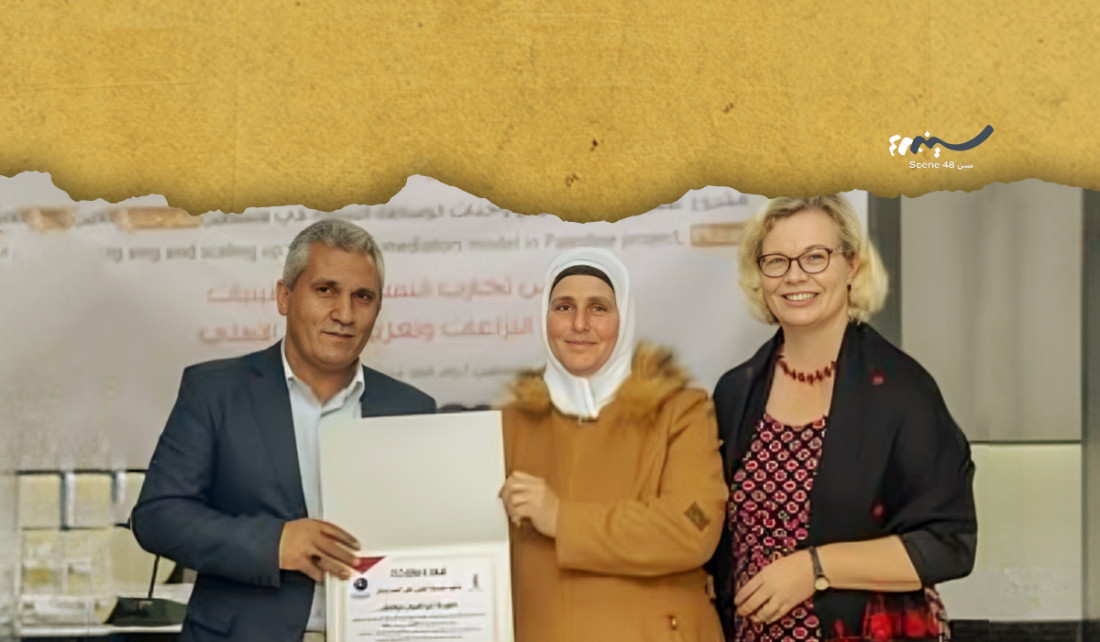
Author's comment: The photos were taken during the project’s final conference, which brought together participating women mediators to share and reflect on their experiences in mediation, conflict prevention, and community peacebuilding. One photo shows Houria participating in the conference session, and the other was taken during the certificate presentation to the mediators at the conclusion of the event.
Project: Women Mediators Clubs Project, implemented by Taawon for Conflict Resolution.
Photo credit: Taawon for Conflict Resolution – project documentation.
Fidaa Barghouthi
A Palestinian gender specialist, researcher, writer, and storyteller. For over two decades, she has worked across gender justice, women's leadership, and peacebuilding. She believes women's voices are living archives of truth; carrying the memory, knowledge, and imagination through which societies can rethink power and create change.
Related Articles