When Wars Dry the Rivers: Natural Resources in the Gulf at the Age of the Iran–U.S. War
The Iran–U.S. war, which began on 28 February 2026, affected a region already facing severe environmental challenges, and it introduced a significant and often overlooked risk to the Gulf region: the security of its water resources.
Before the conflict, the Gulf’s water systems were under significant stress from climate change, poor management, and insufficient infrastructure to compensate for limited natural water sources. The war did not start this crisis but has worsened existing problems in potentially irreversible ways.
Understanding the environmental dimensions of this conflict requires distinguishing between consequences directly caused by the war and the underlying vulnerabilities it exposed. Though related, these are distinct issues.
A Region Built on Substitution
The Gulf Cooperation Council countries (Bahrain, Kuwait, Oman, Qatar, Saudi Arabia, and the United Arab Emirates) have relied on replacing what nature did not provide. The Arabian Peninsula has abundant oil but little freshwater. From 2020 to 2025, these countries spent up to $100 billion to expand desalination. By 2023, 76 percent of their drinking water came from desalinated seawater. Dependence varies, but the trend is clear: desalinated water makes up about 90 percent of supply in Kuwait and Bahrain, 86 percent in Oman, 70 percent in Saudi Arabia, and over 99 percent in Qatar.
This reliance on substitution has been a strategic vulnerability. Civilian survival depends on energy-intensive industrial infrastructure that is centralized, highly visible, and, as shown by the current conflict, vulnerable to targeting.
The Middle East possesses 41.8 percent of global desalination capacity, despite comprising only 6 percent of the world’s population and less than 2 percent of renewable freshwater resources. These figures underscore the region’s dependence on a technology that was not widely available until the mid-twentieth century.
Iran’s Water Crisis Predates the War
Iran’s water problems differ from those of its Gulf neighbors but are just as serious. By 2025, Tehran’s reservoirs held only 12 percent of their capacity. In some areas, years of pumping groundwater caused the ground to sink more than 10 inches annually. Snowmelt from the Alborz and Zagros mountains, which once refilled Iran’s rivers and aquifers, has been shrinking as temperatures rise.
Iran’s supply of drinkable water had been shrinking for years due to climate change, poor management, and infrastructure issues. The war has worsened these problems by adding pressure to Iran’s already stressed water systems, including attacks on dams, reservoirs, and at least one desalination facility.
This context is essential for interpreting recent developments. Iranian officials have accused the United States of attacking a desalination plant on Qeshm Island, allegedly cutting off water to more than 30 villages. Such claims are layered upon pre-existing shortages. The war did not initiate Iran’s water crisis; rather, it has intensified an already critical situation, influencing political dynamics and contributing to social unrest.
Iraq: The Country the War Forgot
Iraq occupies a challenging position in this conflict. Although not directly engaged in hostilities, it is not merely an observer. Iraq’s water crisis may be the most complex among the three countries. Water flow in the Euphrates-Tigris basin has declined 30 to 40 percent over the past four decades, mainly due to upstream dam construction in Turkey and Iran, reduced rainfall, and climate-induced drought. About 7 million Iraqis now face significant reductions in freshwater access. In Basra, home to nearly 3.5 million people and Iraq’s main oil hub, saltwater intrusion from the Gulf via the Shatt al-Arab has steadily increased salinity as freshwater flow diminishes due to upstream dams.
Iran has played a major role in this decline. It has sharply cut the flow of shared rivers like the Diyala, the Arvand, and the Greater and Lesser Zab by building dams. In 2019, Iran announced plans for 109 dams and continues diverting rivers for its irrigation projects in the west. Iraq plans to take legal action at the International Court of Justice over these diversions, showing no binding agreement exists between the two countries on shared water.
The World Resources Institute’s Water Stress Index predicts that by 2040, Iraq will reach a water scarcity level of 4.6 out of 5. The Euphrates will face drought in the south, and the Tigris will have only a small part of its usual flow. The Iran–U.S. war did not cause this directly but has closed off diplomatic options Iraq might have used to address the problem.
As discussed above, it becomes clear that the war has had major direct effects on water infrastructure, though the full impact remains unclear due to limited information during conflicts.
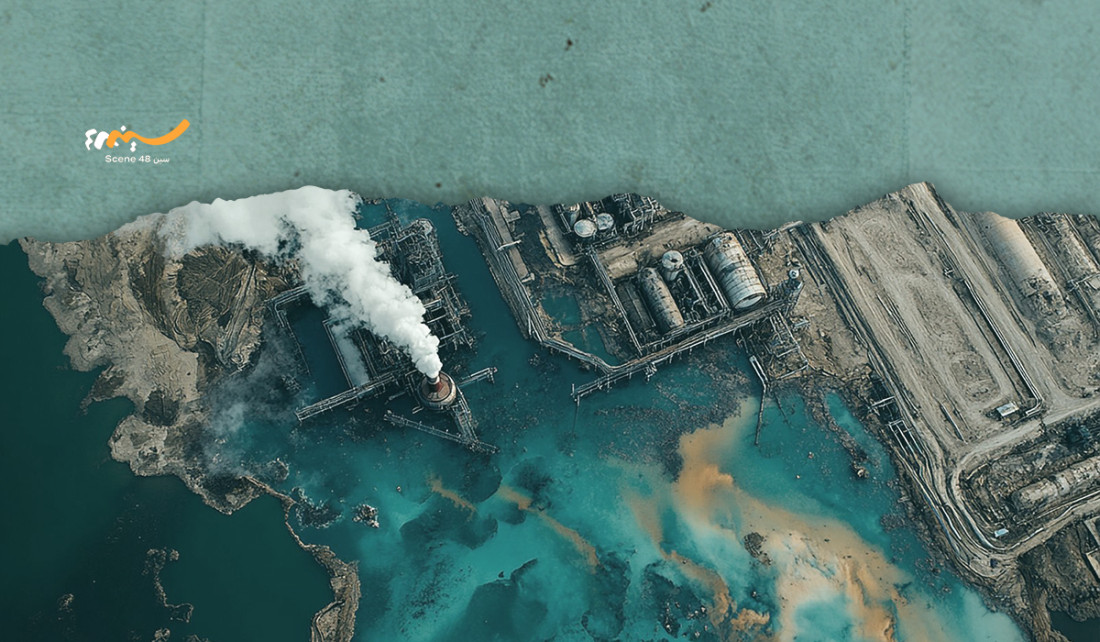
Desalination plants in Kuwait and the UAE were damaged by missile and drone strikes early in the war, while facilities in Bahrain and Iran were reportedly targeted deliberately. An attack on Dubai’s Jebel Ali port came very close to 43 desalination units. On April 6, Israel said it struck Iran’s Pars petrochemical complex in Assaluyeh, and Iran said nearby power and desalination plants were also hit. direct attacks, environmental risks also arise from damage to energy infrastructure. Strikes on oil and gas facilities by U.S.-Israeli and Iranian forces have resulted in substantial oil spills in the Persian Gulf, visible even from space. This oil poses a threat to desalination systems by potentially blocking intake pipes and damaging filters relied upon by millions. Historical precedent exists: during the 1990–1991 Gulf War, Iraq released oil into the Gulf, introducing chemicals that desalination processes could not remove. As a result, Kuwaiti plants were forced to shut down, leaving the country nearly without fresh water and dependent on emergency tankers. Water rationing was implemented, and full recovery required several years.
Another underappreciated risk is the potential Another underappreciated risk is damage to nuclear facilities. Four strikes on Iran’s Bushehr nuclear power plant, near Kuwait and Iraq, have raised concerns about possible radioactive contamination of water used by regional desalination systems. If the plant’s containment is breached, it could cause a disaster comparable to Fukushima, affecting water relied on by tens of millions. Iran appears to be aiming for military victory but wants to gain an advantage by wearing down its opponents. By attacking key water infrastructure, Iran hopes to create divisions between Gulf governments, which it sees as supporting the conflict, and the U.S. and Israeli governments leading it. This could push Gulf capitals to seek an end to a war they did not start.
The second reason is retaliation and setting a precedent. The United States, Israel, and Iran have not signed Additional Protocol I of the Geneva Conventions, which bans attacks on things civilians need to survive, like water facilities. Because none are legally bound, each attack makes the next seem more acceptable.
The impact is most acute in smaller states such as Qatar, Bahrain, and Kuwait, which have minimal water reserves. For these countries, the environmental consequences of the war are an existential threat rather than a peripheral concern.
The Question the Region Must Now Answer
The Iran–U.S. war has added an environmental challenge to Gulf politics that will remain after any ceasefire. Oil production can restart and factories can be rebuilt, but aquifers polluted by radioactive material cannot be fixed quickly. Rivers redirected by dams will not return to normal just because a peace deal is signed.
GCC countries have yet to fully use their regional platform to address water security as a collective rather than solely national concern. The ongoing conflict may prompt a reassessment. However, the broader unresolved question remains whether the region’s environmental systems can withstand a protracted conflict.
In Iraq, the situation is already cause for concern. In Iran, the war is accelerating a crisis already influencing domestic politics. For smaller Gulf states, the margin between stability and disaster may be determined by only a few days’ supply of water reserves.
Traditionally, wars have been analyzed primarily for their political outcomes. The Iran–U.S. conflict necessitates a new perspective that recognizes natural resources, particularly water, as central rather than peripheral to the conflict.

Prof. Mahjoob Zweiri
Professor of Contemporary Politics and History of the Middle East, with a focus on Iran and the Gulf region. He is a visiting professor at the Doha Institute for Graduate Studies and editor at Encyclopedia Arabica. He has held senior academic posts at Qatar University and Durham University, and founded the Journal of Gulf Studies. For more: www.mzweiri.net.
مقالات متعلقة