Reclaiming Intellectual Sovereignty and Sovereign Interiority
“Honest, unrehearsed conversations are crucial to building resilient movements.”
— Mohammed El-Kurd[1]
I know native fluency in Arabic is something that has been taken from me, another effect of the Nakba. Though for a long time, I blamed my father. He avoided speaking Arabic. Once I caught him trying to pass as Lebanese, cornered in a café in Ottawa, surrounded by Lebanese men trying to engage him in conversation. He couldn’t speak to them in French, and, wanting to conceal his Palestinian dialect, he tried to continue the conversation in English. They found him out soon enough, as some words slipped and betrayed his secret accent and geography. I was young, maybe 10 years old. I didn’t know why some Arabs spoke French while others didn’t. I didn’t understand the significance my father’s accent betrayed to his interlocutors. It might have been the first time I heard the word “Palestinian” –from one of the men, saying it in Arabic and then in English– my father, usually so brazen and confident, responding with silence.
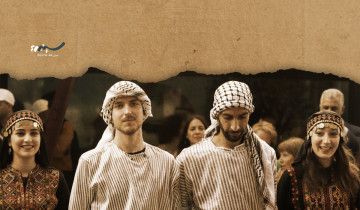
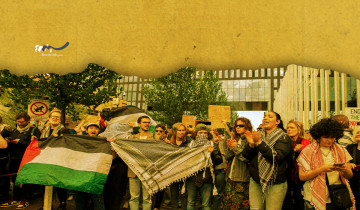
In the North American diaspora, it’s presumably for a variety of reasons that my father had rather donned the cultural position of an amorphous Arab and not specifically a Palestinian. In his recent memoir, Saeed Teebi recounts how he also sought to “blur [himself] away” in the Canadian context; how, after suffering the all-pervasive latent Zionism in the country, he stopped “outwardly identifying as a Palestinian” and rather as “Mediterranean... even a miscellaneous Arab.”[2] In the darkness of the current ongoing genocide and the suppression of international solidarity, Teebi’s candid testimony comes as a signal and light as more and more Palestinians in North America are reclaiming their specific stories, driven to show them publicly and politically. Some are turning to fundraising and community-building through tatreez and dabke groups, some are renewing their faiths. As we concurrently witness such enthusiasm, however, in the New York mayoral election results, for more cultural inclusion into the self-understanding of the imperial metropole, some are concerned that such an invitation of cultural inclusion –one in which we are allowed to be proud of isolated cultural traditions– comes at the cost of a solid political position.
I turn to the work of Palestinian writers who express themselves in English as a way of releasing the diffuse identity of an amorphous Arab (who can’t express herself in Arabic!) toward the groundedness of being a specific Palestinian, with a specific story of catastrophe and return. The embrace of such a specific story, it seems, must by nature be political.[3]
In her work, Rana Barakat, draws on the framework of Critical Indigenous Studies to describe a pivot in writing Palestine that has more than theoretical implications. She writes:
Written outside of a framework of Indigenous resistance, the story of the Nakba is one of endings: the story of the making of a refugee population and the memory of what Palestine once was – as opposed to being the story framed around the return of refugees and Palestinian resistance.[4]
Barakat pivots to a frame of “Ongoing Return,” opening a horizon for Indigenous intellectual sovereignty, releasing a Palestinian self-determination, as required by a settler-(de)colonial lens, which is confined to the status of victim of Ongoing Nakba and defeat. How does one engage in intellectual sovereignty? My understanding is that we speak to each other, in whatever languages we have, regardless of the ghosts that haunt them. There will be ghosts that eavesdrop, and they will take notes, reporting back to some hegemonic authority. But refusing the self-consciousness that any honest expression may be used against us, we insist on creating a sovereign interiority and intimacy among ourselves by which intellectual sovereignty strengthens.
Abdaljawad Omar is another writer who helps me situate my specific story with his generosity of expressing a Palestinian interiority in English. In “Water Without Name,” Omar shares cracks and leaks in a Palestinian masculinity that allows me to relate to my own father’s closed, leakless silence, which excluded and separated me from the wider Palestinian family for so long.[5]
Nasser Abourahme’s text “In Tune with their Time” understands Palestinian resistance in terms of remaining in touch with the historicity of the moment, where the occupation remains arrested in a mythological and timeless moment of conquest, “unable to move past the past.”[6] Where colonial domination is “premised most fundamentally on the logic of non-reciprocity,”[7] Abourahme makes clear why any resistance, whether physical or political, disrupts this non-reciprocity and is thus necessarily read as unrespectable, objectionable, and violent.
These writers satisfy something in me that wants to understand and be understood. But what stabilizes me most and lends me the most specificity in my particular Palestinianness are the contact and conversations I have with extended family who live in the occupation. I know it’s a privilege to have family who are willing and able to share their lives with me in this language, not drawing kinship along linguistic lines, not holding me accountable for decisions made earlier in my ancestry. Beyond any academic or historical understanding of Palestine, which run the danger of reducing Palestine to a case study[8] or elevating it to a long-lost past, the stories I hear and the stories I get to have heard build a communal space, sometimes more foreign than familiar. But it is in keeping in tune with each other’s time, in giving each other access to honest, undefended interiorities, and in being rooted in the building of intellectual sovereignty, that politically viable inclusion and culturally nourishing belonging can happen.
There are so many of us split into so many lived worlds and timelines. There are the ones in the little and the big prisons, engendering miraculous births and visions.[9] There are those in the crucible of the extermination project, exposing to us in threads and reels their lives and deaths and limbs and grief and faith and strength. There are those caught in the webs of occupation, compromising and negotiating and equivocating. There are those in other Arab countries, in European countries, in the Americas and Australia, shadow-boxing discursive ghosts and perceived helplessness. And there are those who call on the free people of the world to rise up and join the struggle; and how much the world has changed because of their call! This may be the spirit that changes everything: the spirit that invokes liberation, where some see only calamity.
[1] Mohammed El-Kurd, Perfect Victims and the Politics of Appeal (Haymarket Books, 2025). [Pg 104]
[2] Saeed Teebi, You Will Not Kill Our Imagination: A Memoir of Palestine and Writing in Dark Times (Simon & Schuster, 2025). [Pgs 96-97]
[3] Rana Barakat relies on the work of Steven Salaita when she declares “Indigeneity is a political category” in: Rana Barakat, “Writing/Righting Palestine Studies: Settler Colonialism, Indigenous Sovereignty and Resisting the Ghost(s) of History,” Settler Colonial Studies 8, no. 3 (2018): 349–63, doi.org/10.1080/2201473X.2017.1300048.
[4] Barakat, “Writing/Righting Palestine Studies.” [Pg 13]
[5] Abdaljawad Omar, “Water without Name,” Communis, September 13, 2025, communispress.com/water-without-name/.
[6] Nasser Abourahme, “In Tune With Their Time,” Radical Philosophy 216 (Summer 2024): 13–20, www.radicalphilosophy.com/wp-content/uploads/2024/09/rp216_abourahme_time-compressed.pdf. [Pg 13]
[7] Abourahme, “In Tune With Their Time.” [Italics in the original; Pg 17]
[8] Sherene Seikaly, “Nakba in the Age of Catastrophe,” Jadaliyya, online at jadaliyya.com/Details/45037.
[9] Basil Farraj and Hashem Abushama , ““Parallel Time”: Cultural Productions from the Small Prison to the Large Prison,” Jadaliyya, online at jadaliyya.com/Details/43980.
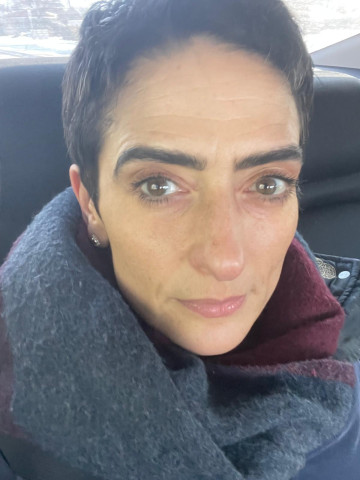
Crina Saad
A professor of literature living on the unceded lands of the Kanien’kehá:ka Nation (Montreal, Canada).
مقالات متعلقة